Abdolali Bagherinejad
Composer, tanbur player, instrument maker and writer
b. c. 1967/68Master Abdolali Bagherinejad is one of the outstanding contemporary artists in the fields of tanbur playing, making traditional Iranian instruments and reviving the Iranian harp (chang). He was born in Kermanshah, and in 1975, at the age of eight, he began learning music with his father and mother. Even in early childhood his talent for, and deep love of, Iranian music, especially the tanbur, were evident.
Musical training and teachers
Bagherinejad began studying the tanbur with great masters of the art. He was a student of:
Seyed Amrollah Shahebrahimi
Seyed Khalil Alinejad
Seyed Hamid Hosseini Gahvarehi
and learned from them the mystical and ancient maqams of the tanbur, the traditional melodies of its repertoire.
In 1980 he was introduced to music theory and set out on a more scholarly and technical path in music.
First steps in instrument making
From his teenage years, and especially from 1982 (at the age of 16), he became interested in making instruments. With the help of his father and his brother he made his first tanbur bowl (the body of the instrument) out of papier-mâché, and later went on to work with wood.
From 1991 he began teaching music formally, and at the same time he became familiar with playing the radif, the canonical repertoire of Persian classical music.
During these years (1991 to 1998) he lived in Khuzestan province, where he taught music and researched the music of the Arab tribes, the Bakhtiari tribe, and the Shushtari and Dezfuli maqams.
He learned from, and was inspired by, local masters such as Mashhadi Kazem Hassanzadeh and Mashhadi Hassan Dobash, as well as the late Bahman Alaeddin (Masoud Bakhtiari).
Meeting the great masters and first harps
In the 1990s he met great masters of Iranian art, including:
Bayaz Amir Ataei
Master Salehi
Master Ghalami (at the Cultural Heritage Organization), and he was influenced above all by Master Amir Ataei.
During this period he came closer to his dream of building the Iranian harp. Master Ataei gave him a great deal of guidance in designing and building this legendary instrument.
In 1993 he brought traditional instrument making into the official programme of the Iran Handicrafts Organization as a discipline.
Professional and international work
Abdolali Bagherinejad has exhibited for more than 20 years at Iranian handicraft exhibitions, and in 2001 he took part in the exhibition in Toronto, Canada, where he showed more than 45 types of Iranian instruments of his own making.
From 2003 he devoted himself professionally to building harps, and he developed a teaching method for Iranian harp playing.
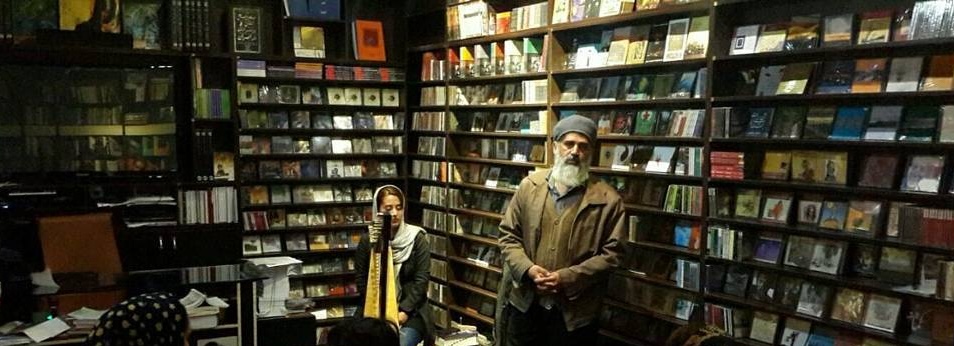
His first students in this field were his wife and two daughters, who today form a family of harp and tanbur players.
In 2008 he received the second-degree artistic rank (an official Iranian qualification for artists) in traditional instrument making.
In the same year he met Master Nader Mashayekhi, through whom he took courses with Professor Ernestine Stoop (a Dutch harpist) and perfected his harp-playing skills.
Research and innovation in reviving the Iranian harp
So far he has reconstructed several examples of ancient harps:
two Sasanian-era harps (based on the rock reliefs of Taq-e Bostan in Kermanshah)
one Islamic-era harp (based on the image “Moghanni Sorud”, “The Singing Minstrel”), and he is currently reproducing an ancient harp based on 6,000-year-old inscriptions from Khuzestan.
He is the only artist in the world who plays the harp and the tanbur simultaneously in an orchestral setting.
Works and teaching
In 2003 he published a valuable teaching collection titled Amuzesh-e Moghaddamati-ye Tanbur (“Elementary Tanbur Lessons”), designed for beginning tanbur students.
The book covers:
an introduction to the tanbur
basic exercises
the maqam Ali Ali
the maqam Jelowshahi (strokes and frets)
pieces such as Ya Mowla Delam Tang Umadeh (“O Mowla, My Heart Has Grown Heavy”), Khosha Anan (“Blessed Are Those”) and Yavaran (“Companions”).
An artistic family
Master Bagherinejad’s family is regarded as the only Iranian harp-playing family.
Together with his wife and two daughters, he combines harp and tanbur in stage performances and in teaching, and the family represents the bond between the new generations and Iran’s ancient music.