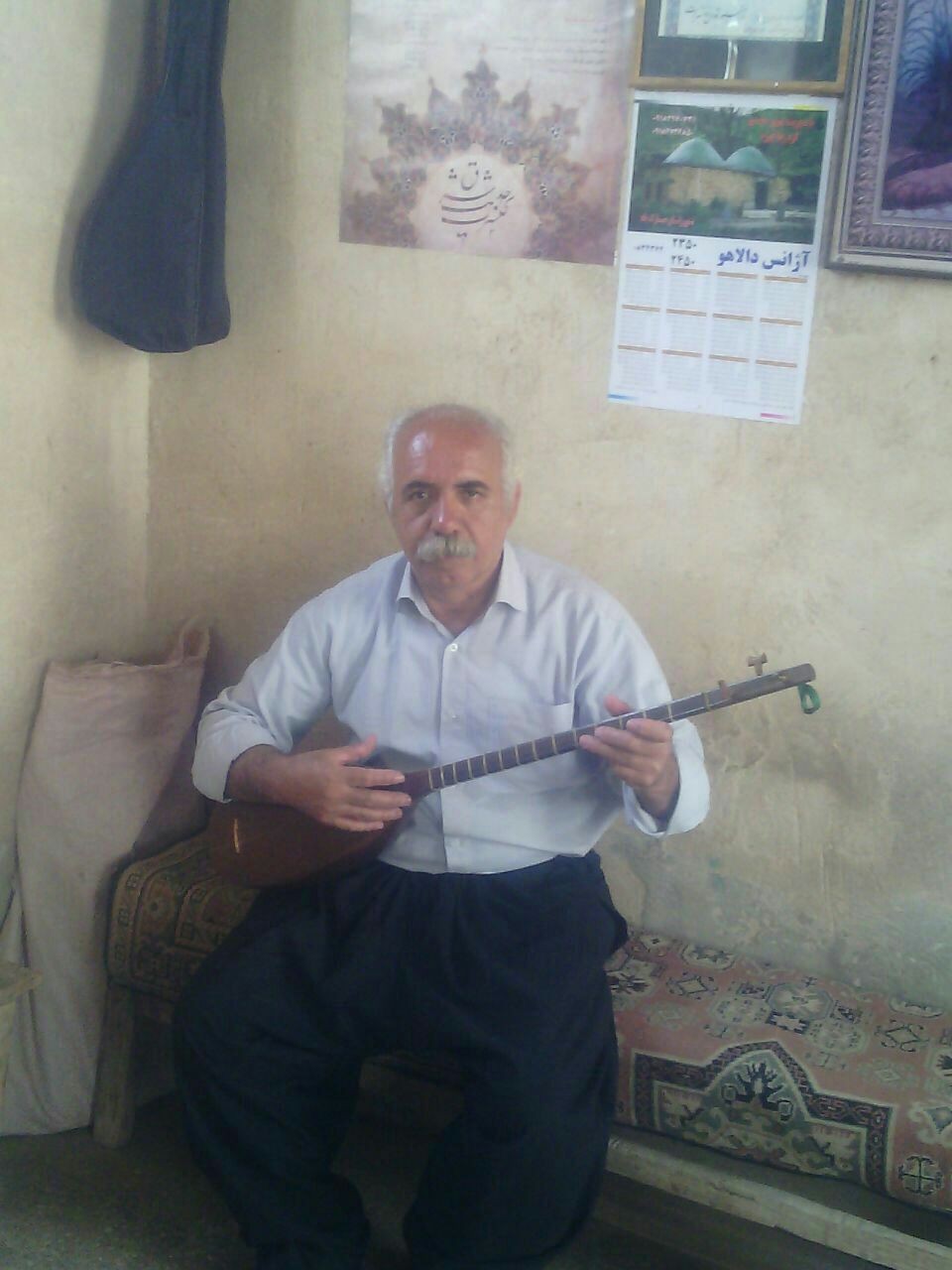
Asadollah Farmani
Tanbur maker, player and maqam master
b. 1955/56The Farmani family of Gahvareh
For seven generations this family has made tanburs and served the people of the Yarsan community and this ritual, sacred instrument. It owns the oldest tanbur-making workshop, more than 250 years old, which has been run from generation to generation:
Farman
Soleyman
Fathali
Hossein
Changiz
Shamsollah
Asadollah and his brothers Yadollah, Ezzatollah and Fardin
Unfortunately no works survive from Farman, Soleyman and Fathali, or else they were lost in the attacks of past centuries. The oldest existing tanbur, however, is by Hossein: two of his tanburs survive, dating from 1170 SH (1791/92), more than 220 years ago. One of them is kept by the Farmani family and the other in the Khamush tekyeh (a religious gathering house) in the town of Gahvareh.
Changiz Farmani
Changiz Farmani was one of the greatest tanbur makers. Besides building instruments he also played the tanbur well, and he trained students such as his son and grandsons, Asadollah, and Taher Yarveysi.
Asadollah relates that Changiz usually set the frets (dastan) of the tanbur using the maqams (traditional melodic pieces or modes of the tanbur) Tarz-e Rostam and Sartarz, because these two maqams are played across all the frets in two different tunings.
Asadollah Gahvareh
Asadollah is today the most renowned tanbur maker. He builds his instruments, which enjoy a worldwide reputation, together with his brothers Yadollah, Ezzatollah and Fardin; the quality and ring of an Asadollah instrument are known to everyone.
Asadollah, son of Shamsollah and grandson of Changiz, was born in 1334 SH (1955/56). From the age of six he began working under his grandfather Changiz, tying on frets, sanding and attaching soundboards, and at the age of ten he built his first tanbur as a piece of handwork. He is also one of the great tanbur players and maqam masters, and learned his first maqam from Changiz at the age of ten.
Speaking about the manner and style of his work, Asadollah says that it has changed little since the old days: they build instruments in the same traditional way their ancestors did, and their tools are still the adze and the chisel – the only difference being that instruments today are made more finely and precisely than in the past.
Asadollah believes that modern machines fill all the pores of the wood, jumble its grooves and choke the sound of the instrument. Working the wood with traditional tools, he says, naturally gives the instrument a better sound.
The bowl of the instrument is made from pear, apricot, mulberry and walnut wood, cut from a log 180 cm to 2 m in diameter, which is divided into four equal parts.
The soundboard of the tanbur is made of pure, dry mulberry wood from a cold region, seasoned for at least ten years, and buffalo horn is used for the string holder.
The tanburs made by Asadollah and his brothers are offered to lovers of the instrument under the famous stamp “Asadollah Gahvareh”.
Source: Telegram channel “Navaye Tanbur”, 12 December 2016; quoting the book Zamineh-ye Shenakht-e Tanbur by Heydar Kaki.