
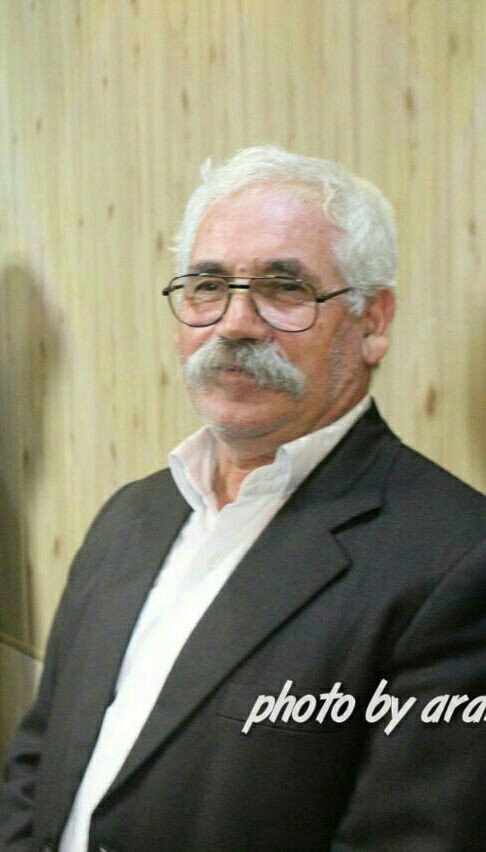
Seyed Amin Rasaei
Scribe of the Yari daftars, author and tanbur player
b. 1956/57A great man whose name rings sweetly in the ear of every devout believer, and who is counted among the well-known figures of the Yari faith: this great Yarsan figure is none other than Agha Seyed Amin Rasaei.
Seyed Amin was born in 1335 SH (1956/57) into a devout family in the village of Gurehjub Moradbeyg.
Spiritual matters and, more generally, faith, religion and piety were so important in his family, and held such a high place, that already in early childhood he developed a remarkable inclination towards and intimacy with spiritual things and the precious teachings of the Yarsan, including the playing of the sacred instrument, the tanbur; so much so that at the age of seven, among a number of Yarsan elders, he played the maqam (a traditional melodic piece of the tanbur) Bariyeh for the first time.
He was a younger son of Agha Seyed Karim and the brother of the late Agha Seyed Rahbar and of Agha Seyed Safar Rasaei, and under the guidance of Agha Seyed Karim, himself a master of the tanbur maqams, he learned this sacred instrument while still a child. In the study, interpretation and understanding of the precious teachings of the daftars (the Yarsan sacred books), however, it was his esteemed brother Agha Seyed Rahbar who took on this important task and became his teacher.
It should be added that his brother Agha Seyed Rahbar was so touched by divine grace that it was as if something were being inspired within him, which brought him into a state of rapture; this was so intense that he became madly thirsty for the encounter with God, lost himself and entered the world of rapture and intoxication with the Divine Essence. For this reason, in 1347 SH (1968/69), in this very state of rapture, he fell from the peak of Divanegah, left the transient world and attained the nearness of God.
After his brother's death, Seyed Amin made full use of his brother's daftar writings and himself turned to copying the sacred Yari daftars. Among these copies are the blessed daftar of Darvish Nowruz, made in 1350 SH (1971/72), and the daftar of Darvish Barakhas Biyamehi, Darvish Hoseynali and Darvish Vali Majrilani, made in Bahman 1353 SH (January/February 1975).
Notably, at the time of the Baathist regime's invasion of Iranian territory, he was held captive in a foreign country for ten years, from 1359 to 1369 SH (1980/81 to 1990/91). Even then, true to his lofty spirit and devotion to the sacred tenets of the Yarsan, in the confines of his captivity he set up classes in tanbur playing, daftar reading and the interpretation of the daftars for his fellow Yarsan prisoners, who numbered some 77, and, drawing on his knowledge of these languages, taught English and French to Yarsan and non-Yarsan prisoners alike.
Remarkably, in order to spread the rites and sacred values of the Yarsan faith, including tanbur playing, among his brothers in faith, this esteemed Seyed managed to build tanburs out of the most basic materials, which were rarely to be found, and to teach the Yarsan prisoners there to play. Agha Seyed Amin Rasaei is one of the few people who played a very important role for their friends and brothers in faith in upholding the Yari faith and the sacred norms and values of the Yarsan, such as tanbur playing and daftar reading, and who thus repaid his debt to the faith despite the harsh conditions of the enemy camps and the complete lack of freedom and adequate means.
When his captivity ended and he returned home in 1372 SH (1993/94), he devoted himself to copying the daftars of the Forty (Chehel-tan) of Seyed Brakeh.
He is the author of numerous articles and works, among them:
the valuable book Rahrovan va Baqa-ye Javedan (“The Wayfarers and Eternal Abiding”), 361 pages covering ten subjects, 1382 SH (2003/04)
Taqvim-e Kordi-ye Pardiwari va Sabk-e Guran (“The Kurdish Pardiwari Calendar and the Guran Style”), 1383 SH (2004/05)
the book Razha-ye Nahofteh (“Hidden Secrets”), 89 pages, 1387 SH (2008/09)
Tajalli-ye Nur (“The Manifestation of Light”), 249 pages in fifteen parts, 1388 SH (2009/10)
Osul va Arkan-e Yari (“Principles and Pillars of the Yari Faith”), comprising 150 pages, 1390 SH (2011/12); owing to his workload, the writing of this book has not yet been completed
a critique of a book whose title the source gives as Marnavaz Dariche-ye Pardiwar (reading uncertain), 97 pages, 1391 SH (2012/13)
the valuable book Pir Narges Cham, 174 pages covering 18 subjects, 1391 SH (2012/13)
a critique of an interview with Seyed Borzu Daneshvar, 36 pages, 1393 SH (2014/15)
a brief survey and critique of the book by Hojjat al-Eslam Mansouri, 34 pages, 1393 SH (2014/15)
a critique of the book Bang-e Sarhaddan, 88 pages, 1394 SH (2015/16)
and a book entitled Resaleh-ye Yari-ye Yarsan (“Treatise on the Yari Faith of the Yarsan”), 232 pages in 35 parts.
At present, since 1382 SH (2003/04), on the instruction of the beloved Yarsan leader Agha Seyed Nasreddin Heydari, this great Yarsan figure has been serving the Yari faith and the whole Yarsan community as a member of the board of trustees of the holy shrine of Sultan Sahak.
Source: Telegram channel “Navaye Tanbur”, 15 June 2017; written by Seyed Hekmat Hosseini; quoting the channel “Navaye Yari”.
Music
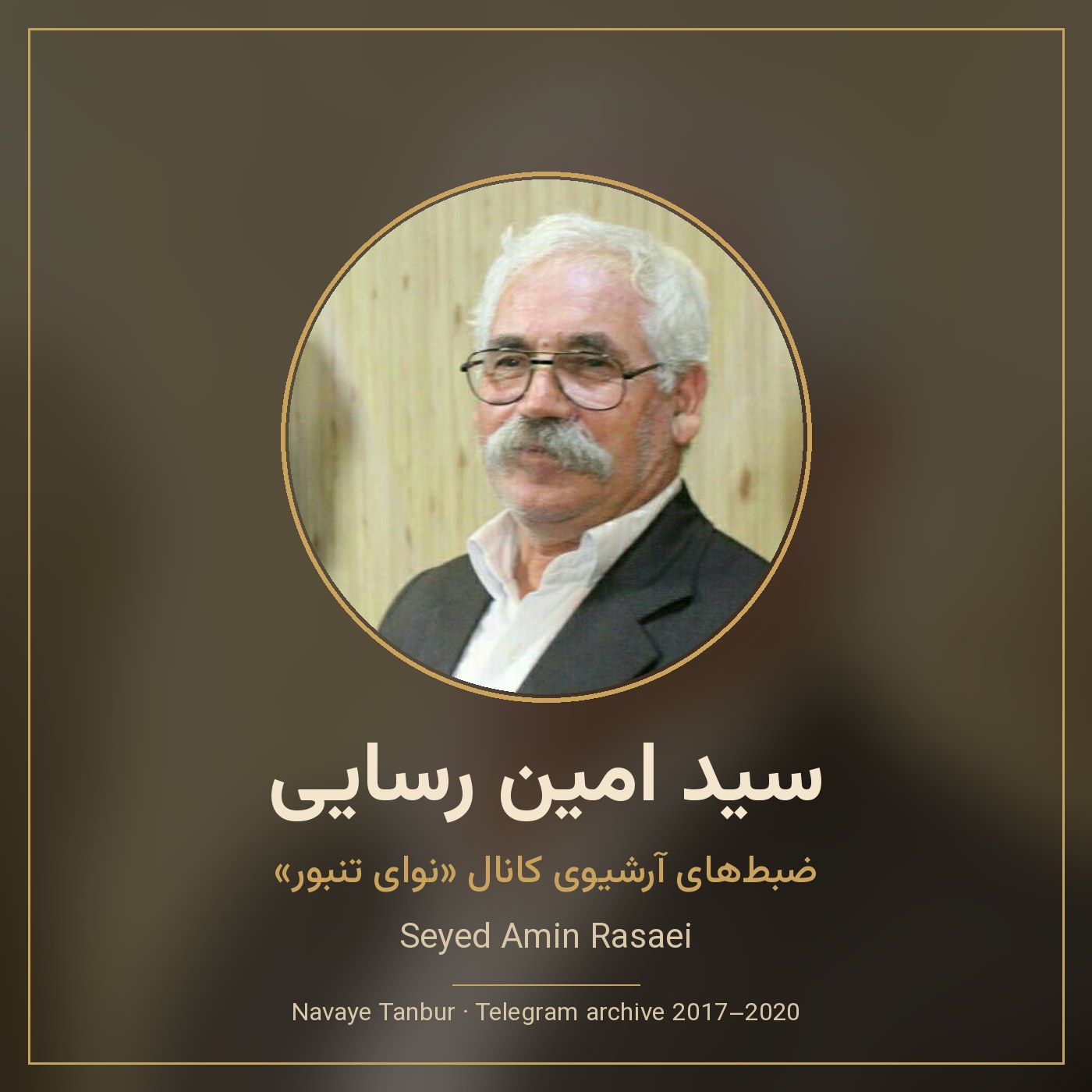 Kalam in the maqams Shah Khoshini, Hey Gian, Ey Imanem Yar and Gian Khwajay Gholaman · Recordings of Seyed Amin Rasaei from the Navaye Tanbur channelPerformer · آواز
- Maqam Bariyeh · Recordings of Seyed Amin Rasaei from the Navaye Tanbur channelPerformer
- Maqam Hey Lava Khamushi · Recordings of Seyed Amin Rasaei from the Navaye Tanbur channelPerformer
- Maqam Shah Khoshini · Recordings of Seyed Amin Rasaei from the Navaye Tanbur channelPerformer
- Recordings of Seyed Amin Rasaei from the Navaye Tanbur channelArtist
- Sheikh Amiri prelude (Pishravi) · Recordings of Seyed Amin Rasaei from the Navaye Tanbur channelPerformer