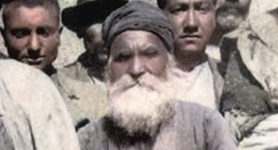
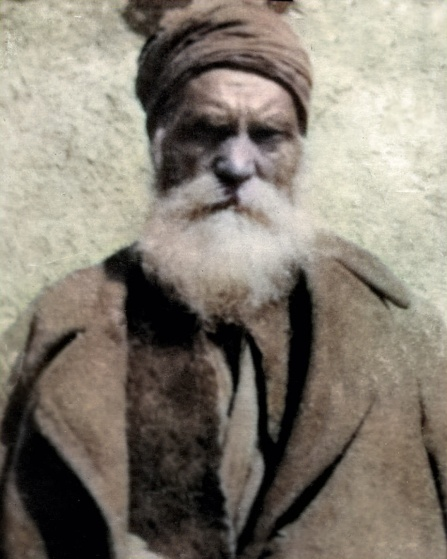
Seyed Nasreddin Khamushi Jeyhunabadi
Composer and tanbur player
d. 1949/50Mystic, maqam master and one of the great elders of the Sahneh tanbur school
The revered Seyed Nasreddin Khamushi Jeyhunabadi, known among the Yaran, the faithful, as Asi Nasreddin or Agha Seyed Nasreddin, was a descendant of the great family of Seyed Abolvafa, son of Soltan Eshaq, one of the Haftavan (the seven holy figures) of the Yarsan faith, also known as Ahl-e Haqq, a mystical religion of western Iran. He lived in the 19th century and the first half of the 20th century in the Jeyhunabad area of Sahneh county, in Kermanshah province.
Lineage and family
Seyed Nasreddin came from the Khamushi family, a family rooted in a lineage of mystics and elders (pirs) of the Yari (Yarsan) faith. His ancestors were direct followers of Soltan Sahak (Soltan Eshaq) and among the principal bearers of the tradition of the tanbur and of the Yari kalams, the sacred hymns of the Yarsan. His father, Seyed Nureddin Khamushi, was one of the great masters of the tanbur maqams; he preserved and taught the ancient Yarsan maqams, the traditional melodies of the tanbur repertoire. Seyed Nasreddin grew up from childhood in this spiritual and musical atmosphere, and from the very beginning he blended the melodies of the tanbur with dhikr (the ritual remembrance of God) and sama (mystical listening and ecstatic movement).
Spiritual and musical path
He was not only skilled in playing maqams and singing kalams; spiritually, too, he was counted among the mystics blessed with spiritual unveiling and known for miraculous gifts. People of the spiritual path believe that the melodies and maqams Seyed Nasreddin left behind were not the product of musical experience alone but arose from inspiration and spiritual revelation.
He spent many long years in dhikr, meditation and seclusion and trained many students in his school. Among them are the revered Baba Gholam Hemmatabadi, Hossein Ruhtafi, Seyed Ayaz Ghazvinei, Seyed Ghadamyar Hosseini, Darvish Amir Hayati, Abdolmohammad Sharbati and Seyed Azim Arzhang; each of them later became a distinguished master and maqam expert of the Yarsan in his own right.
Musical legacy and the Khamushi maqams
Seyed Nasreddin’s most important legacy is the seven tanbur maqams known by his name. According to the belief of the Yarsan, these seven maqams were revealed to him in a state of inspiration and spiritual rapture, and they reflect the original form of some of the ancient maqams of the eras of the holy Shah Khoshin and Soltan Sahak.
These maqams are:
Soltan Sarjam – the melody of the glory and presence of the Sultan of Truth.
Taleh-Savaran – the sound of lovers moving across the field of the spiritual path.
Ya Zat-e Seyed Khamush – the maqam of meditation and of silence in the divine essence.
Tuni Jaf Shirin-Zavan – the sound of divine tenderness and love.
Haq Dosa Miteh – the melody of the unity of the human being and the Divine Truth.
Chapdas-o Sanjaneh (Jam-e Sohbat-e Sanjaneh) – the maqam of collective dhikr and the union of souls.
Sarmale-ye Sheykhan – the maqam of union with the Truth and of passing away in it.
Not only musically but also spiritually, these melodies form a symbolic system, and in the Sahneh tanbur tradition they are known as the “Seven Stations of the Spiritual Path”.
Standing among the people of the path
Among the Yarsan elders it was customary for every spiritual wayfarer to compose or hand down a maqam, but Seyed Nasreddin was one of the few under whose name a complete set of seven maqams was recorded. This distinction gave him an outstanding place among the people of dhikr and of the tanbur.
It is told that in dhikr gatherings, when the assembly reached a state of ecstasy, the reciters would call out the name “Asi Nasreddin” and play one of his maqams so that hearts might melt in the presence of the Truth.
Death
After many years of teaching and spiritual guidance, the revered Agha Seyed Nasreddin Khamushi Jeyhunabadi passed away in 1949. His blessed body was buried on top of a hill overlooking the village of Jeyhunabad. Today the place is a shrine for lovers of God and the devout, and it is known as the qibla (spiritual focal point) of mystics and of the people of tanbur dhikr.
Spiritual legacy
The name and memory of Seyed Nasreddin flow through the soul of the Yarsan like the melody of the tanbur. He revived the bond between dhikr and melody and turned the tanbur from a mere instrument into a mystery. Whenever one of his maqams is played, his spirit is present among those gathered for sama, and his melody still resounds from the hills of Jeyhunabad to the hearts of the lovers.