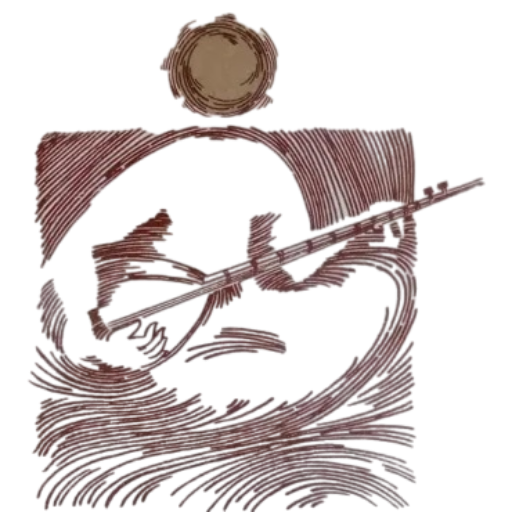
Construction of the tanbur
The tanbur looks simple, but every part affects its sound. Sizes and details vary from maker to maker; the figures below are approximate.
Main parts
Part | Description |
|---|---|
Body (kaseh) | The pear-shaped resonator, usually mulberry. Either carved from one piece or built from 7–10 glued staves. |
Soundboard | The thin top over the body. Usually mulberry, sometimes walnut, with a few small sound holes. |
Throat | Where the body joins the neck. |
Neck | Usually walnut; sometimes plane or apricot wood. |
Frets | 13 or 14 frets of gut or nylon, tied around the neck and movable. |
Nut | A small piece of wood or bone at the top of the neck with grooves for the strings. |
Pegs | Wooden tuning pegs, usually three, fitted straight into the head of the neck. |
Bridge | The small support on the soundboard that the strings rest on. |
Tailpiece | Where the strings are fixed at the end of the body. |
The instrument is about 80–90 cm long and the body about 16 cm wide.
Strings
The tanbur originally had two strings. Ostad Elahi added a third that doubles the upper string; most tanburs today have three strings, two of them paired, and the melody is played mostly on the pair. Strings were once silk and are now metal: usually steel for the upper strings and copper or wound for the lower.
Fretting
The tanbur has fewer frets than the setar or tar, and its scale is close to semitones, though the position of some frets differs slightly between schools and players. Because the frets are tied, a player can move them for different tunings.
New instruments in the tanbur family
Bam-tar: a larger, lower-pitched tanbur used in groups such as the Shams Ensemble.
Tantar: a double-sided instrument, tanbur on one side and setar on the other, made by Fereydoun Haghighi (2003).
Delsaz: an innovation by Saeed Zolnouri.
For how the instrument is made, see Makers and Fash village.
Sources: Mohammad-Reza Darvishi, Encyclopedia of the Musical Instruments of Iran; The New Grove Dictionary of Music and Musicians; ostadelahi.com; Wikipedia.
About the tanbur: What is the tanbur? · History · Construction · Tuning and technique · Maqams · Makers and Fash village · Buying and care · Where to start