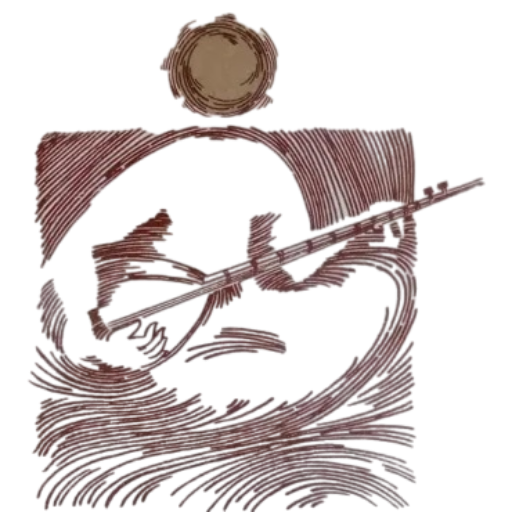
History of the tanbur
The tanbur belongs to one of the oldest known families of string instruments. It is worth separating documented history from legend: long-necked lutes are very old, but today’s Kermanshahi tanbur took its present form in recent centuries.
Ancient traces
Mesopotamia: long-necked instruments resembling the tanbur appear in images from the Akkadian period (third millennium BC).
Susa: among the clay figurines from Susa, from around 1500 BC, one figure holds a tanbur-like instrument.
Parthian and Sasanian periods: the tanbur was widely played, and the word appears in Parthian and Middle Persian texts. Tradition links it to the Sasanian court and musicians such as Barbad.
The Islamic period
Al-Farabi, in the 10th century, described two kinds of tanbur in his Great Book of Music: the tanbur of Baghdad and the tanbur of Khorasan. Avicenna, Safi al-Din Urmavi and Abd al-Qadir Maraghi wrote about it too.
Poets: from Ferdowsi to Rumi and Hafez, the tanbur appears again and again in Persian poetry. Rumi’s lines on “the lament of the tanbur and some other instruments” are often quoted by tanbur players today.
The tanbur and the Yarsan
In later centuries the tanbur became the ritual instrument of the Yarsan (Ahl-e Haqq) in western Iran. In the Guran region — including towns such as Gahvareh and Kerend — and in Sahneh, it was learned orally, from generation to generation, together with the sacred kalam. Families such as the Farmani family of Gahvareh have made tanburs for several generations.
The 20th century: from the jamkhaneh to the stage
Nour Ali Elahi (1895–1974), known as Ostad Elahi, added a third string, popularised the farangi tuning and the use of all the fingers of the right hand, and established the tanbur as a serious instrument for improvisation.
Seyed Amrollah Shah-Ebrahimi (1923–2003) of Sahneh brought the tanbur and its maqams into official music circles in the 1970s.
Keykhosrow Pournazeri founded the Shams Ensemble in 1980, the first group to bring tanburs on stage as an ensemble alongside Persian classical singing.
Ali Akbar Moradi of Guran recorded the old maqams and performed them around the world.
Seyed Khalil Alinejad (1957–2001) formed the Baba Taher ensemble in 1989 and trained a generation of players through his compositions and teaching.
Today
The tanbur is now taught at universities and music schools across Iran, and festivals such as Kohan Avaha-ye Tanbur are held. Alongside the maqam tradition, a new generation — including many women players — also uses the tanbur in contemporary music.
For further reading, see The Tanbur from Ancient Times to the Present and Zamineh-ye Shenakht-e Tanbur in the site library.
Sources: “Tanbūr” in The New Grove Dictionary of Music and Musicians; Mohammad-Reza Darvishi, Encyclopedia of the Musical Instruments of Iran; ostadelahi.com; artist pages on Tanburban.
About the tanbur: What is the tanbur? · History · Construction · Tuning and technique · Maqams · Makers and Fash village · Buying and care · Where to start