People
Tanbur player, composer and teacher; director of the Rah Sama group
Rah Sama music group (Tabriz Tanbur School)
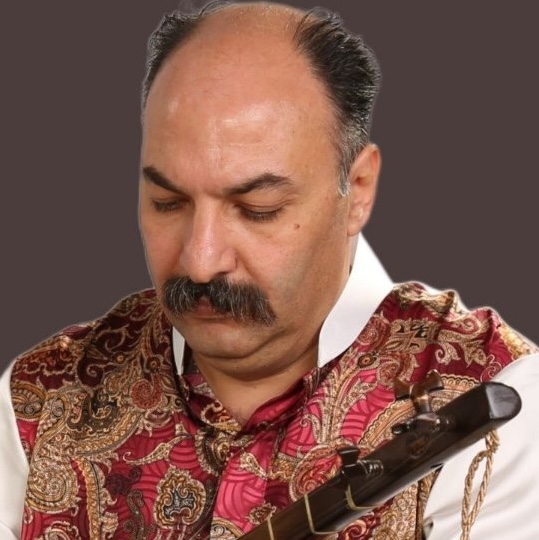
Sasan Shekarian is a tanbur player, composer and tanbur teacher in Tabriz. He directs and composes for the Rah Sama music group, which calls itself the “Tabriz Tanbur School”. Shekarian has worked with the group since at least 2014; at the concert “Hadis-e Shargh” (Tabriz, 2014) he was composer, arranger and tanbur soloist. Most of the group’s recent works – among them “Dowlat-e Eshgh”, “Buy-e Eshgh”, “Man Mast o To Divaneh”, “Sama-e Zarkuban” and avaz pieces on poems by Shah Ismail Khatai – are his compositions. His tanbur lessons are collected in two courses: Tanbur lessons with Sasan Shekarian (Persian) and Tənbur Təlimi (Azerbaijani). The group’s channel also carries talks on the history of the tanbur in Azerbaijan and on playing techniques. Sources: Rah Sama YouTube channel; Tabriz Tanbur School on Instagram.
Tanbur player, composer and maqam expert
Ranaei Family Ensemble
Shirin Mohammadi is a tanbur player, composer and maqam expert. She was born in the village of Darvishan near Sahneh, in Kermanshah province, into a family of artists and mystics, and is regarded as one of Iran’s best-known women tanbur players. Her acquaintance with the haqqani and ancient maqams of the tanbur began in childhood, through the voice of her father, Seyed Khan Mohammad. She began playing the tanbur with Seyed Yahya Ranaei and learned setar from Jalal Zolfonoun, Fariborz Azizi and Masoud Shoari. She first studied the vocal radif of Persian classical music with Afsaneh Rasaei, and later attended the vocal radif analysis classes of Hossein Alizadeh, Masoud Keramati and Enayat Shafiei. In 1381 SH (2002/03) she received a licence from the Ministry of Culture and Islamic Guidance to make tanburs and setars, and became a member of Iran’s House of Music. She has given many concerts in Tehran and in other cities around the world, and has also left lasting work with the Nasl-e Khalil tanbur ensemble. Her work includes the album “Bang-e Sahari”, devoted to the majlesi (assembly) and ancient maqams of the tanbur, in which she sought to record part of her knowledge of the tanbur maqams for students. The album was well received. The maqams performed on it are: Baya Baya Pishvaz-e Janan Jelowshahi Khan Amiri and Sahari Sarukhani Sama Semeli Sama Savar Savar Tarz Majnuni With the Ranaei Family Ensemble she has sung and played the tanbur, for example in “Bani Adam”, “Motreb-e Tanbur” and “Yawaran Masem”. Her YouTube channel carries her tanbur performances of maqams, such as Jang-e Ra and Shah Khoshini, and her own compositions, such as the song “Janan-e Man” (2023). Sources for this paragraph: Shirin Mohammadi’s YouTube channel; the Ranaei Family Ensemble’s YouTube channel.
Tanbur player, Soule Mast ensemble
Soule Mast tanbur ensemble
Shirin Shirebrahimi is a tanbur player and member of the Soule Mast tanbur ensemble led by Ebrahim Tehranipour. This page is short and will be expanded.
Composer, maqam expert and tanbur player
Baba Taher ensemble · Shams ensemble
Siavash Ashrafi is a composer, maqam expert and tanbur player from Kangavar who played alongside Seyed Khalil Alinejad in the Shams and Baba Taher ensembles. He plays in both the Dalahu (Guran) and the Sahneh styles. A close relative of Yadollah Ashrafi, he carries on Yadollah’s way of playing. Together with Kambiz Mohitmafi, Fereydoun Haghighi and a few others, he is counted among the masters with a style of their own who have received less recognition than they deserve. Learning by ear Ashrafi began playing the tanbur at 13 or 14. Living in a provincial town with no teacher, he learned the style of Darvish Amir Hayati from his cassettes. He says he practised through the night to master Hayati’s shor technique, playing until his nails bled. Years later, when Hayati visited the region and heard him play, he encouraged him, saying he had never heard anyone play this style so sweetly. Ashrafi believes listening matters more than watching in learning the tanbur. Shams and Baba Taher In 1988/89 he met Seyed Khalil Alinejad, who invited him to play tanbur at the 22 Bahman festival in an ensemble led by Keykhosrow Pournazeri; he then did much work with the Shams and Baba Taher ensembles. He remembers Seyed Khalil as a teacher of both music and ethics. With the ensemble he also performed in Sweden and Norway. Teaching and views on the tanbur Ashrafi is selective about students and cares about their character, but leaves fees to what each student can afford, saying that “music is not for sale”. He sees the tanbur as a ritual instrument, “a breed apart”, whose structure should not be changed and which should stay untouched — a view he says Seyed Khalil shared. He also plays zarb and daf. Video An old Lori melody on the tanbur Sources: his profile on tanbur-music.ir, based on Forough Askari’s interview with him in the newspaper Isfahan-e Ziba (no. 1618).
Composer, tanbur and setar player
1949/50–2022
Shams ensemble
Siavash Nourpour (Kermanshah, 1328 SH – 17 July 2022) was a composer, teacher and player of the tanbur and of plucked string instruments such as the tar and setar. He was born on 19 December 1949 (28 Azar 1328 SH) in the Feyzabad quarter of Kermanshah, was one of the first members of the Shams ensemble and founded the music group “Moshtaq”. The song “Mardan-e Khoda” is among his best-known works. Life and training Nourpour turned to music at the age of seven. His father, seeing his talent and enthusiasm, took him to Gholam Zendehdel, a pupil of Darvish Khan in Kermanshah, and from the age of ten he attended Zendehdel’s classes. He then studied with Haji Khan Nazeri and his son Keykhosrow Pournazeri. From 1350 SH (1971/72) he learned the radif of Persian music with Mansour Maarefi, and until 1353 SH (1974/75) he worked with the Kermanshah Culture and Art orchestra. He studied solfège with Shahrestani and Mohammad Ushal; prosody, the book “Bohur al-Alhan” by Forsat al-Dowleh Shirazi and the works of Abdolqader Maraghei and Abu Nasr Farabi with Ahmad Ardalan; vocal music, masnavi singing and vocal dictation with Ebrahim Kimand; and the conservatory textbooks with Ali Nazari. Three times he won first place at provincial level in the tar competitions of the Ramsar camp, and in 1349 SH (1970/71) he attended Ali Akbar Shahnazi’s intensive tar classes there. Activities At the suggestion of Nour Ali Boroumand he began collecting Kurdish music, work that can be heard on several of his albums. In 1358 SH (1979/80), with the support and supervision of Masoud Zanganeh at the Centre for the Preservation and Propagation of Music, he brought together a group of tanbur players, arranged the song “Baz Hava-ye Vatanam Arezust” — based on melodies of the Qaderi dervishes of Kurdistan — in avaz-e Bayat-e Esfahan, and recorded it with the singer Heshmatollah Lornejad. The group then performed for ten nights at Vahdat Hall in Tehran with Seyed Jalaleddin Mohammadian as singer. In 1359 SH (1980/81) he took part in setting up the Shams tanbur ensemble under Keykhosrow Pournazeri, whose members included Seyed Khalil Alinejad, Ali Akbar Moradi, Golnazar Azizi and Shahram Nazeri. The ensemble’s first concert, with Seyed Jalaleddin Mohammadian singing, took place in Tehran. That same year Nourpour recorded the songs “Baz Hava-ye Vatanam” and “Mardan-e Khoda” with Shahram Nazeri for the radio; after Pournazeri added a verse, they were released on the album Sedaye Sokhan-e Eshgh. After leaving Shams he performed and recorded pieces from time to time for Kermanshah radio and television and taught music. In 1368 SH (1989/90) he formed the “Moshtaq” group with a number of his students and appeared at Vahdat Hall. Heshmatollah Lornejad, Hossein Alborzi, Ali Alie’i and Mojtaba Zarrinmah were among the singers of this very active group, which continued until Lornejad’s death in 1374 SH (1995/96). In 1381 SH (2002/03), at the invitation of Mazhar Khaleghi, he gave a concert in Sulaymaniyah in Iraqi Kurdistan together with artists such as Mahmoud Merati and Akbar Izadi, and in Bahman 1397 SH (January/February 2019) he was honoured at the opening of the 34th Fajr Music Festival in Kermanshah. Nourpour died in Kermanshah on 17 July 2022 (26 Tir 1401 SH) after a period of illness; his death was announced by Shahram Nazeri. Works “Mehrnushan”, solo tar and setar, with Ahmad Khaktinat on daf and Hamid Moghaddam on tombak “Dang-e Del”, sung by Heshmatollah Lornejad and Hossein Alborzi “Armaghani az Bakhtaran”, sung by Behrouz Karimi Sedaye Sokhan-e Eshgh, sung by Shahram Nazeri Selections from the Fajr Music Festival, sung by Mojtaba Zarrinmah and Hossein Alborzi The songs “Baz Hava-ye Vatanam” (Lornejad, Mohammadian, Nazeri), “Mardan-e Khoda” (Ali Alie’i, Mohammadian, Nazeri), “Jang Jangeh Vataneh” (Manouchehr Taherzadeh), “Selseleh-ye Mu-ye Dust” (Lornejad), “Zamzam” (Hossein Alborzi) and “Yar Bi” Source for his death: Sarpoosh, July 2022.
Tanbur player
Saman Soltanipour is a tanbur player. His YouTube channel has performances from two concerts, “Tooreneh” (tanbur and percussion) and “Shoq-e Majnun”, including the tanbur solos “Baraye To” and “Shab-navazi” and a tanbur–udu duet in “Baran-e Sahari”. Source: his YouTube channel (@samansoltanipour).
Tanbur player, Khorasan Tanbur Players
Khorasan Tanbur Players ensemble · Soule Mast tanbur ensemble
Soroush Sobhani is a member of the Khorasan Tanbur Players ensemble led by Ebrahim Tehranipour. He studied the tanbur with Tehranipour. He also played tanbur in the Soule Mast tanbur ensemble. This page is short and will be expanded.
Tanbur player, Soule Mast ensemble
Soule Mast tanbur ensemble
Soudabeh Moghaddam is a tanbur player and member of the Soule Mast tanbur ensemble led by Ebrahim Tehranipour. This page is short and will be expanded.
Tanbur player and maqam singer
d. 2016/17
The late Ebrahim Tabarzard (in some posts “Tabarzad”) was a tanbur player and maqam singer from the Kalkal Sanjabi tribe and the son of Babaali Tabarzard. He died young in a car accident; the ceremony for the first anniversary of his death was held on Friday, 26 Khordad 1396 SH (16 June 2017), at the Ahl-e Haqq jamkhaneh (the Yarsan ritual gathering house) in Qasr-e Shirin. Between December 2016 and March 2020 the “Navaye Tanbur” channel published several of his performances: the maqams (traditional melodic pieces of the tanbur) Khamushi and Barieh, the ancient maqam Geleh-o Dareh, Barieh, the maqam Yari and Tarz-e Yari (video). Some of these recordings were sent to the channel by his son Meysam Tabarzard, whose own performances of the maqams Barieh and Yari also appear in the channel. Source: Telegram channel “Navaye Tanbur”, 2016–2020, and the notice of his first death anniversary (June 2017).
Composer, arranger and tanbur player
b. 1976/77
Amirhossein Tafreshipour is a composer, arranger, singer and tanbur player of the instrument’s new generation, born in Tafresh in 1355 SH (1976/77). He studied music from his teens: in 1368 SH (1989/90) he began the santur with Farzaneh Zand, then studied the setar with Jalal Zolfonun and Masoud Shoari, after which he turned to the tanbur and learned the Guran tanbur with Ali Akbar Moradi. He also spent several years learning the Khorasani dotar with Saeed Tehranizadeh — an instrument that, together with the tanbur, the Azerbaijani qopuz and the chogur, belongs to the same family of plucked string instruments. Tafreshipour has played in many concerts with the Lavach Tanbur Ensemble, led by and performing the compositions of Ali Akbar Moradi, and also played on Moradi’s album Do Valeh. He has performed as a soloist with the Kamerata string orchestra under its conductor and composer Keyvan Mirhadizadeh, and played and sang on the album “Kohneh Hawaran” (a tanbur concerto) by the same composer. Most of his own work consists of new arrangements based on Yari tanbur maqams and Kurdish songs, in which instruments such as duduk, clarinet, kamancheh, double bass and percussion join the tanbur. He also plays an instrument he calls “Parnian”. His albums include In Hamani (Identity) and Zisteh (Lived). The mystical dimension of the tanbur, which sets it apart from other string instruments, lies at the heart of his work and albums. Part of this entry is based on the video descriptions on his YouTube channel (@amirhosseintafreshipour4762).
Tanbur player, Ravak ensemble
Ravak tanbur ensemble
Taha Esmaeili is a tanbur player and a member of the Ravak tanbur ensemble led by Saeed Pirzadeh, and played tanbur in the ensemble’s first published performance (November 2026). Source: the opening credits of the Ravak ensemble’s video on the YouTube channel “Tanbur Tutorials with Saeid Pirzade”. This page is short and will be expanded.
Tanbur player, Guran Tanbur Players
Guran Tanbur Players
Taha Soltani is a tanbur player and a member of the Guran Tanbur Players, led by Jahanbakhsh Rostami in Shiraz, and played tanbur with the ensemble in the song “Parvaz-e Ruh” (2025) and the concert “Sokhan-e No” (2025). Sources: the description of the “Parvaz-e Ruh” video on Jahanbakhsh Rostami’s YouTube channel and the ensemble’s Instagram page. This page is short and will be expanded.
Tanbur player and teacher
Artistic career Hamzeh Taheri is a tanbur player and teacher. According to the description of his book Daftarcheh-ye Tanbur (“The Tanbur Notebook”), the work is the result of more than two decades of experience in playing and teaching. In summer 2022, tanbur courses at beginner, intermediate and advanced levels, as well as courses in maqam playing (maqams being the traditional melodic pieces of the tanbur repertoire) and ensemble playing, were held on the basis of his “Daftarcheh-ye Tanbur” teaching method. On 25 April 2025 Taheri was among the performers at a concert by the Kariz Ensemble at the Hilaj Theatre in Tehran. Works The video teaching series “Daftarcheh-ye Tanbur”, compiled by Hamzeh Taheri, has been published on YouTube since summer 2022: a preface, a table of contents and forty lessons, comprising five lessons of music theory, ten lessons of elementary exercises, twenty-one tasnifs (metrical songs) and four majazi (figurative) maqams. The lessons include pieces by Gholamali Pouratayi, Keykhosrow Pournazeri and Seyed Khalil Alinejad, Khorasani and Azeri folk songs, and maqams such as “Jelowshahi”, “Chupi” and “Gol-o Khar” (“Rose and Thorn”). Notes and files for each lesson are available on the “Daftarcheh-ye Tanbur” Telegram channel (t.me/tanbourlearning). The series’ title music was composed by Taheri and Shoeib Kaminpour; its graphics are by Siamak Pourjabbar and its motion graphics by Ali Sadeghi. The book and multimedia collection “Daftarcheh-ye Tanbur” was launched on 5 January 2024 at Shahr-e Ketab Markazi (the Central Book City), with Taheri and Ali Sadeghi present. Over sixty lessons, the 135-page book covers everything from the fundamentals of music theory and playing technique to the performance of pieces and maqams; its illustrations are by Siamak Pourjabbar and its graphic design by Shabnam Ghavidast.
Tanbur player, maqam player and kalam singer
b. 1967/68
Bijan Tamari is an accomplished student, and also the son-in-law, of one of the great figures of the Yarsan community, Taher Yarveysi. He was born in 1346 SH (1967/68) in the village of Qaleh Kahush in the Guran area. As a teenager, while still at school, and because of the interest and talent he perceived in himself, he set out to learn from Taher Yarveysi the authentic tanbur maqams (the traditional melodic pieces/modes of the tanbur), the singing of the kalams (the sacred hymns of the Yarsan) and the way of understanding and interpreting the teachings of the daftars (the Yarsan sacred books). Yarveysi's considerate and affectionate manner spurred him to ever greater effort and enthusiasm as a student, in learning the sacred principles of the faith and in making rapid progress in tanbur and maqam playing, so that it can be said that in 1367 SH (1988/89) he attained the rank of master in tanbur and maqam playing. His firm resolve and high aspiration led Tamari to follow the way of his predecessors and to pass on everything he had learned in this field to the devotees and lovers of the Yarsan religious path. Accordingly, there are today many devoted and eminent people who have satisfied their thirst for learning the sacred principles of the faith, tanbur playing and kalam singing at the feet of the esteemed master Bijan Tamari. It should be noted that the valuable principles and the correct way of tanbur playing and kalam singing of great masters of earlier times, such as Seyed Vali Hosseini, Darvish Alimir Darvishi, Darvish Jahangir Darvishi, Maaref Amiri and Mahmoud Ghanbari, played a significant and special role in Tamari's development and ever-growing progress. He has always attributed his progress to the grace of God, to the tireless efforts of Yarveysi and to taking the distinguished masters named above as his models and inspiration; and so he always speaks in praise and admiration of these great figures of the Yarsan community. Source: Telegram channel “Navaye Tanbur”, 2 February 2017; written by Seyed Hekmat Hosseini; quoting the channel “Yaran-e Dalahu”.
Composer, tanbur player and music producer
Khorasan Tanbur Players ensemble · Soule Mast tanbur ensemble
Ebrahim Tehranipour is a composer, tanbur player and music producer. He leads the tanbur ensemble “Soule Mast”, which has performed in Mashhad since 2013 and plays works by Seyed Khalil Alinejad, Kaykhosrow Pournazeri and Mohammad-Reza Lotfi. More recently he has also led the “Khorasan Tanbur Players” ensemble, including concerts in Tehran. He sings in some performances and plays together with his brother Amirhossein Tehranipour. Source: his official YouTube channel (@ebrahimtehranipour) and website (ebrahimtehranipour.com).
Ritual maqam singer, calligrapher and copyist of Yarsan scriptures
d. 2026
The late Ostad Ali Tiyatraj (in some posts “Tiyatranj”) was a respected member of the Yarsan community: a scholar and singer of the ritual maqams, a calligrapher, a painter and a copyist of the Yarsan scriptures (daftars). From 2017 the channel “Navaye Tanbur” posted several maqams in his voice, among them Sheikh Amiri Guran (“Ey dus ni dam da”), Ali Ali Hu and Hana Faryadras Davud, and in August 2017 one of his paintings. Death On 24 June 2026 (3 Tir 1405) the channel announced his death, calling him a man of good deeds and good name in the Yarsan community. A few days later a text from a group of his friends described his large funeral and remembered his humility, sincerity and charity and his many students and admirers. Source: Telegram channel “Navaye Tanbur”, July 2017 to June 2026. Photo from the death notice.
Kalam singer, tanbur teacher and ensemble leader
b. 1972/73
Dalahoo tanbur ensemble
Farrokh Yadegari was born in 1351 SH (1972/73) in Sarpol-e Zahab county, in Kermanshah, a province rich in artists. He is a first-class member of the Iran Music House (Khaneh-ye Musiqi). From childhood he learned from veteran masters, but his constant place was in the singing of the kalam (the sacred hymns of the Yarsan) in the jamkhanehs (the Yarsan ritual gathering houses) of Kerend, Sahneh and Kermanshah. Displacement caused by the war imposed by Iraq turned out to be a fortunate turn for him: during his high-school years he won national prizes with student ensembles. The first group he formed was the Shahed ensemble, which won first and second places nationally in 1367 and 1368 SH (1988/89 and 1989/90). Then in 1372 SH (1993/94), together with the masters Keyvan Qalkhani, Faramarz Amirian and Houshang Amirian, he founded the Dalahu ensemble; in more than twenty-five years of activity they took part in all the national music festivals and won top national titles, plaques of appreciation and the crystal statuettes of these festivals. Farrokh Yadegari, however, turned his aim towards teaching young Yarsan people and teenagers in the town of Sarpol-e Zahab and in the villages of Zahab and Dalahu, Posht-e Tang of Qalkhani, because it was from this area that the Yarsan and tanbur culture had spread to other regions, yet no kalam singer or tanbur player was to be found there any more, and the tanbur culture was dying out. Now, thanks to his efforts, more than a hundred pupils in the Qalkhani villages and a hundred pupils in the town of Sarpol-e Zahab are learning in classes for the sacred instrument, the tanbur, under his supervision. This worthy undertaking was carried out with the permission of the venerable sayyids of the Heydari tekyeh of Tutshami. The largest ensemble, the Shahu maqam (traditional melodic pieces of the tanbur) players’ ensemble, made up of his pupils and led by him, within a very short time won second place nationally at the Zagros-neshinan (Zagros dwellers) festival and was also selected in the maqam music section of the Festival of Epic Melodies (Navaha-ye Hamasi). In Ordibehesht 1395 SH (April/May 2016) the Shahu tanbur maqam ensemble was selected in the veterans’ section of the ninth national Regional Music Festival in Kerman, and at the closing ceremony of the festival Farrokh Yadegari and thirty other artists were honoured as veterans. The Shahu tanbur maqam ensemble is currently the largest tanbur maqam ensemble in the country. Source: Telegram channel “Navaye Tanbur”, 6 December 2016; written by Seyed Hekmat Hosseini.
Kalam singer and tanbur player of Guran
1934/35–2016
The Yadegari family of sayyids has been one of the influential artistic families in tanbur playing and kalam (the sacred hymns of the Yarsan) singing in the Guran region over the past century; they live in the village of Simani near Gahvareh, on the slopes of Mount Panj Savareh. The late Seyed Fattah was the best-known tanbur player of this region; he learned the tanbur from the greatest master of his time, Master Sarkhaw. The late Seyed Khiyal and the late Seyed Naser Yadegari, sons of Seyed Fattah and themselves renowned tanbur players, were among his most outstanding pupils. Seyed Khiyal Yadegari, born in 1313 SH (1934/35), one of the great contemporary kalam singers and tanbur players of the Guran region of Kermanshah, registered 105 maqams (traditional melodic pieces of the tanbur) of Iran’s music. From childhood he began learning the tanbur from his father with great dedication. Since tanbur players enjoyed a high standing among the people, and out of his love for the tanbur and its ancient maqams, he accepted every difficulty and hardship, and through practice and perseverance, his apprenticeship with his father and his attendance at ceremonies and kalam gatherings he learned all the maqams of the tanbur. Yadegari gradually became known as a master and authority on tanbur music, and in ceremonies and jamkhanehs (the Yarsan ritual gathering houses) he fulfilled to perfection, through his tanbur playing and kalam singing, his duty of preserving and spreading the music of the tanbur. Playing the tanbur at the eighth Regional Music Festival, Seyed Khiyal was honoured as one of the veterans of tanbur music. After 81 blessed years he passed away in his birthplace on Tuesday, 20 Bahman 1394 SH (9 February 2016). Source: Telegram channel “Navaye Tanbur”, 21 November 2016; quoting the Telegram channel “Chefteh Diyar Kur Kur Neshin”.
Tanbur player
Seyed Naser Yadegari is a tanbur player. An archival recording of him playing the maqams “Tarz-e Yari”, “Dawala” and “Sarukhani” has been re-published on Seyed Vesal Hoseini’s YouTube channel. No further biographical information was found in available sources. Source: Seyed Vesal Hoseini’s YouTube channel.
Tanbur maker and player, founder of instrument making in Fash village
b. 1921/22
Ostad Yadollah Ashrafi, son of Shir-Mohammad, was a tanbur maker and player. He was born in 1921/22 (1300 SH) in the village of Fash near Kangavar in Kermanshah province and lived to about 86, working until the end of his life. Instrument making in Fash — today one of the largest centres for making tanbur, tar and setar in Iran — began with him. From woodwork to instrument making His father was a farmer, a wood craftsman and a devotee of Imam Ali. Following him, Yadollah turned to woodwork and for years made doors, windows, tables and chairs. Then, given the special place of the tanbur among the Kurds of Kermanshah province, he began making tanburs, and later tars and setars as well. His instruments were known in Kermanshah, Hamadan, Shiraz, Tehran and the north of Iran. In 1987/88 he went to Seyed Khalil Alinejad in Sahneh to deepen his knowledge. Playing Ashrafi also played the tanbur, performing the maqams Tarz-e Majnuni and Saqi-nameh in a distinctive, moving style. While working he would softly recite Rumi, and sometimes Hafez and Saadi. Siavash Ashrafi, a close relative, carries on his style of playing. Students and legacy He was a gifted teacher of instrument making. According to his students, more than 300 families in Fash now make instruments, all directly or indirectly his students, and perhaps more than a thousand people earn their living through the craft he founded. Fereydoun Haghighi is also one of his students, as was his nephew Mehrab Ashrafi, who learned to make tanbur and setar from him. Character He is remembered as sociable, hospitable and generous; he often gave instruments to students who could not pay, asking only for their prayers. Though slight in old age, he worked faster than the young. He often said he wished his coffin to be carried out from his workshop — that is, to keep making instruments until his last breath. Source: a tribute by one of his students, who studied with him for a year in 1988 on tanbur-music.ir.
Tanbur player and maqam singer
1939–2016
Yadollah Teymouri, one of Kermanshah's distinguished tanbur players, was born on 28 Mordad 1318 (20 August 1939) in Kermanshah. As a child he was drawn to the instrument by the sound of his father Abdollah Teymouri's tanbur, and he learned the kalams, maqams and nazms of the tanbur from his father and from Seyed Qasem Afzali. Over some seventy years he played and sang with devotion and mastery, and introduced students such as Jalil Jahangard and Jamil Rahmati to Iran's regional music community. Death and commemoration Yadollah Teymouri died on the morning of Monday 10 Aban 1395 (31 October 2016) after months of lung disease. The news came from his nephew Kamran Hemmatpour, a university lecturer and regional-music researcher, who also announced two CDs of his playing, "Sheikh Amiri" and "Tarz-e Rostam", to be published by Avaye Hananeh. On Wednesday 21 Tir 1396 (12 July 2017) at 8:30 pm a commemoration for him and for Molaverdi Khajehvand, player of the ashiq saz, was held at the Arasbaran Cultural Center in Tehran, with talks by the organologist and researcher Abdolreza Majdi and Maryam Gharasou, professor of ethnomusicology at the University of Paris Nanterre, and music by Seyed Arash Shahriari Jalil Jahangard and Jamil Rahmati. The album "Tarz-e Rostam" In 2022 the album "Tarz-e Rostam", Kurdish maqam music composed, played on tanbur and sung by Yadollah Teymouri, was released by Avaye Hananeh. It has eight pieces: "Alvan Alvan", "Tarz-e Rostam", "Shah Khoshin", "Kakeh Sayi", "Galeh o Darreh", "Majnuni", "Monajat" and "Monajat 2". Source: Musiceiranian (musiceiranian.ir) — تنبورنواز پیشکسوت کرمانشاهی; مراسم نکوداشت هنرمندان فقید مولاوردی خواجه وند و یدالله تیموری; آلبوم «طرز رستم» از زنده یاد یدالله تیموری منتشر شد
Yarsan tanbur player and kalam singer
Khalifeh Yarmorad is a Yarsan tanbur player and kalam singer. Firooz Yousefi has published recordings of him playing and singing, including maqam “Tarz-e Yari” and a kalam from the book “Zabur-e Haqiqat”. Source: Firooz Yousefi’s YouTube channel.
Composer, tanbur player and singer
1940/41–2019
Taher Yarveysi was born in 1940 in the town of Gahvareh, part of Dalahu county in Kermanshah province, into a Yarsan family (the Yarsan being a Kurdish mystical faith). He began playing the tanbur at the age of ten and studied the melodies and maqams of maqam music (maqams being the traditional melodic pieces of the tanbur repertoire) with Master Changiz Farmani. Among his most important teachers were Seyed Vali Hosseini, one of the most eminent players of his time, and Master Birkhan (Lalu Birkhan), one of the renowned masters of the Zardeh area (Dalahu). Yarveysi also learned the craft of making the tanbur from Master Changiz Farmani and later trained many students himself in Tehran, Kermanshah and the Guran region. He devoted his life to maqam music and the ritual melodies of the tanbur and was regarded as one of the most authoritative references for this traditional music. Death Taher Yarveysi died on 16 July 2019 at Bisotun Hospital in Kermanshah, after a period of illness during which he had been in a coma. Performances Among the programmes and festivals in which he took part: Festival of Culture and Art (1975) Mirror and Song Festival (1994) Eslamabad-e Gharb Festival of Poetry and Literature (2001) Qasr-e Shirin Festival (2001) Eslamabad-e Gharb Music Festival (2001) Tehran Ritual Festival (2001) Sanandaj Festival (2002) Zekr and Zakerin (Invocation and Invokers) Festival, Mashhad (2003) Sahneh Tanbur Festival (2003) Kerman Maqam Music Festival (2003 and 2004) Ramsar Festival (2004) Performance at the Niavaran Cultural Center (2004) Berlin Festival of Ritual Music, Germany (2001) Concert in Tajikistan (2004) Performance of the ancient maqams of the tanbur at the Conference on the Ilami and Kermanshahi Languages, Erbil, Iraqi Kurdistan (2005) Album Majnuni (“Love’s Madness”; a collection of the tanbur’s majlesi maqams, those played at social gatherings) Death and burial Taher Yarveysi had long struggled with various illnesses and spent his last days in the intensive care unit of Bistoun Hospital in Kermanshah. He died at noon on Tuesday 25 Tir 1398 (16 July 2019). He was buried on Wednesday 26 Tir in the cemetery of Gahvareh, and the memorial was held in the Ahl-e Haqq jamkhaneh of Gahvareh. Mohammad Allahyari, director-general of the music office at the Ministry of Culture, described him in a condolence message as a leading figure in making and playing the tanbur. The death notices called him one of the most important living authorities on tanbur maqam music of his time. Musiceiranian's report has him starting the tanbur at twelve (the text above says ten) and names Seyed Vali Hosseini as his first and most influential teacher. His students are spread across Tehran, Kermanshah, the Guran region and Kurdistan. National registration According to Nafiseh-Sadat Abdolbaghaei, speaking with Heydar Kaki, the first national heritage file that she and Farzad Bazgir prepared for the tanbur, guided by Ali-Akbar Moradi, was devoted to Yarveysi, based on filmed interviews with him. It was entered in Iran's national heritage list under number 1252. A file to nominate him for the list of the heritage of humanity was also in preparation but remained unfinished after his death. Farid Elhami counts him among the last tanbur "narrators" (ravi) of the Guran region. Source: Musiceiranian (musiceiranian.ir) — استاد «یارویسی» تنبورنواز برجسته کرمانشاهی درگذشت; طاهر یارویسی امروز تشییع می شود; «طاهر یارویسی» ابدی شد; مدیر دفتر موسیقی ارشاد درگذشت طاهر یارویسی را تسلیت گفت; حیدر کاکی: احداث خانه تنبور مهمترین اتفاق هنری کرمانشاه بود
Tanbur player and kalam singer from Guran
b. 1956/57
Ostad Mohammad Yasemi, known as “Mohammad Kuchak-Beli”, was born in 1335 SH (1956/57) in the village of Kuchak-Bel near Gahvareh in Guran. His father, the late Ebrahim Khan Yasemi, was a player and singer of the kalam maqams, and his brothers, the late Askar Khan and Akbar Khan, were also versed in the maqams and the tanbur. He learned the heritage of the Yarsan rite from them and other masters of Guran. After the death of his father and brothers, family duties and work as a farmer and gardener made life hard for him, but from the 1980s he took up the tanbur and the Yarsan kalam maqams again. At a time when few could record music, cassettes of his kalam singing circulated at the night gatherings of tanbur lovers. He is counted among the elder performers and transmitters of the Yari kalam maqams of his time. According to his interviewer, after losing his loved ones he sang maqams such as Bariya, Gharibi, Pawa Mori and Mama Sikhani so heavily and sorrowfully that listeners were moved to tears. In the 1980s he set the meeting of Sultan Sahak and Pir Mikail Dudani to a melody of his own (“Aw Pir Mikail Dudani mawa”), which the same source calls the first performance in this style. The channel “Navaye Tanbur” has posted several of his performances, among them the maqams Sarukhani, Dawala and Bariya, Mohammad Hasan Khani, and Qatar and Bariya with Kourosh Sabouri. Source: Telegram channel “Navaye Tanbur”, April 2017 to July 2026; biography from an interview by Alireza Abbasi Gurajubi (15 June 2026).
Tanbur player and author of tanbur books
b. 1976/77
Yashar Behnoud is a player and teacher of the tanbur and bağlama and an author of tanbur method books, born in Tabriz in 1355 SH (1976/77). He is also versed in instruments related to the tanbur, such as the bağlama and chogur, and plays them with skill. Behnoud began playing the tanbur as a child, in 1368 SH (1989/90), with his grandfather, Ostad Javad Dousti. Dousti was a student of Ostad Abedin Khademi and played the haqqani maqams in the Guran manner, so Behnoud too first came to know the Guran style. As a teenager he met Ostad Pirnia, on whose advice he began studying the majlesi and majazi maqams of the tanbur with Nader Ghazanfari, a student of Seyed Amrollah Shahebrahimi; in this way he also learned the Sahneh style. His knowledge of different tanbur styles and his command of notation laid the groundwork for his method books. Behnoud holds a degree in mechanical engineering from the University of Tabriz. His three-volume series “Amuzesh-e Tanbur” (Tanbur Method) was published by Nay-o-Ney between 1390 and 1395 SH (2011–2016) and is used by many tanbur teachers. He also co-wrote the book “Pargar”. Behnoud leads the Moshtagh tanbur ensemble, which had been directed by his teacher Nader Ghazanfari since 1359 SH (1980/81); he has carried on his teacher’s work there. With the ensemble he has given more than thirty concerts in Iran, Turkey and Germany. “Khosrow-e Mahruyan”, the first album of his own compositions, was officially released in spring 1397 SH (2018).
Documentary maker and music teacher (Farhad Moradi)
Firooz Yousefi (Farhad Moradi) is a music teacher and the maker of documentaries on the music of Kermanshah and Kurdish music. His four-part documentary “The Yarsan Tanbur from the Perspective of Guran”, made with Dayrak Soltani, looks at the tanbur in poetry and historical sources, the accounts of its masters, its maqams, the areas where it is played and the lives of its teachers in the Guran region. His series “Kermashan, Source of Art and Artists”, made with Dayrak Soltani and Musa Babakhani, was broadcast on Tishk TV’s “Bisotun” programme; one episode is a biography of Ostad Ali Akbar Moradi. He has also published recordings of Yarsan elders singing kalam and playing tanbur, and of the Khavandkar feast. Source: the video descriptions on his YouTube channel (@firoozyosofi7541).
Tanbur player, Guran Tanbur Players
Guran Tanbur Players
Zahra Mahouzi is a tanbur player and a member of the Guran Tanbur Players, led by Jahanbakhsh Rostami in Shiraz, and played tanbur with the ensemble in the song “Parvaz-e Ruh” (2025) and the concert “Sokhan-e No” (2025). Sources: the description of the “Parvaz-e Ruh” video on Jahanbakhsh Rostami’s YouTube channel and the ensemble’s Instagram page. This page is short and will be expanded.
Member of the Khorasan Tanbur Players
Khorasan Tanbur Players ensemble
Zahra Naseri is a member of the Khorasan Tanbur Players ensemble led by Ebrahim Tehranipour. This page is short and will be expanded.
Tanbur player, Moshtagh Tanbur Ensemble
Moshtagh Tanbur Ensemble
Zanyar Mohammadinasab is a tanbur player and a member of the Moshtagh Tanbur Ensemble in Sanandaj, led by Jalil Rahmati, and played tanbur in “Hoo Madadi” in memory of Mohammad-Reza Lotfi (October 2025). Source: the closing credits of the “Hoo Madadi” video on the Moshtagh Tanbur Ensemble’s YouTube channel. This page is short and will be expanded.
Maqam singer, tanbur player and poet
Divangeh ensemble
Majid Zarei is a maqam singer (maqam: a traditional melodic piece of the tanbur), tanbur player and poet. Between 2016 and 2018 the channel “Navaye Tanbur” published dozens of his performances of tanbur maqams, among them Qatar, Bariyeh, Khamushi, Sarukhani, Sartarz, Gharibi, Tarz-e Rostam, Baba Na‘usi, Shah Khoshini, Paveh-mori, Hejrani, Soltan Dineh, Davaleh and the preludes Pardiwari and Sheikh Amiri. In some of them, such as Hejrani and Paveh-mori, the poem, the tanbur and the singing are all his own. Among his Kurdish poems is one in praise of Dol Dalan and Tutshami, which ends with a line in which he calls himself “Majid, the least, the dust of your threshold”. Zarei leads the tanbur and kalam (sacred Yarsan hymns) ensemble Divanegah. The group went on pilgrimage to the Heydari tekyeh on 22 March 2017, on 5 November 2017 and again on 22 March 2018, playing the tanbur and singing kalams there. He has also led collective kalam singing, for example on the first night of Khavandkar (31 October 2017); a collective kalam with Ghobad Ghobadi was also shared by the channel. He has sung maqams with other groups as well: in December 2017 he was the maqam singer of the Mehregan ensemble at the Zagros Hall in Marivan, with Seyed Qodrat Alavi and others on tanbur. In January 2018 he was the singer of the tanbur ensemble Yad-e Yaran, with Sirous Karami, Arash Salimi and Milad Mohammadi, at the city hall and at the opening of a documentary photo exhibition on the Kermanshah earthquake; later that month the municipality and city council of Kermanshah gave the group a certificate of appreciation. On 24 August 2018 he sang maqams, with Seyed Qodrat Alavi on tanbur, at the Festival of Unity and Solidarity of Iranian Peoples. Zarei also teaches the Yari maqams to children; performances by Mohammad Veysi and Parham Najafi, two of his young pupils, were published by the channel. Source: Telegram channel “Navaye Tanbur”, March 2017 to August 2018 (captions of performances and photos).
Tanbur player, Guran Tanbur Players
Guran Tanbur Players
Zohreh Zarei is a tanbur player and a member of the Guran Tanbur Players, led by Jahanbakhsh Rostami in Shiraz, and played tanbur with the ensemble in the song “Parvaz-e Ruh” (2025) and the concert “Sokhan-e No” (2025). Sources: the description of the “Parvaz-e Ruh” video on Jahanbakhsh Rostami’s YouTube channel and the ensemble’s Instagram page. This page is short and will be expanded.
Tanbur and setar player, music teacher
b. 1969
Life and education Seyed Mohammad Zolnuri was born on 23 September 1969 in Sahneh County. He began playing the tanbur at the age of thirteen with his maternal uncle, Seyed Jamshid Sotvan, and later went on to study with the late Master Seyed Ayaz Ghazvinei to deepen his knowledge. In 1984 he learned the setar (a small long-necked Persian lute) with Majid Rezaei, and soon afterwards, in Shiraz, he was introduced to the school of Master Zolfonun by Dr Saeed Niakousari. In 1992 he learned the techniques of setar playing at a professional level from Master Hossein Alizadeh. From 1993 Zolnuri studied music at university, where he learned from teachers such as Farhad Fakhreddini, Mostafa Kamal Pourtorab, Hassan Riahi and Mohammad Sarir, and later from Master Pirniakan and Masoud Shoari. Artistic career In 1998 he founded the Keyhan Ensemble, which has given many performances in cities across Iran. From 2011 to 2015 Zolnuri taught classes in the style of Hossein Alizadeh, attended by students from Tehran, Qazvin, Mashhad, Tabriz and Gorgan. In 2015 he served on the jury of the Youth Music Festival.