People
Composer and tanbur player
b. 1977
Shams ensemble
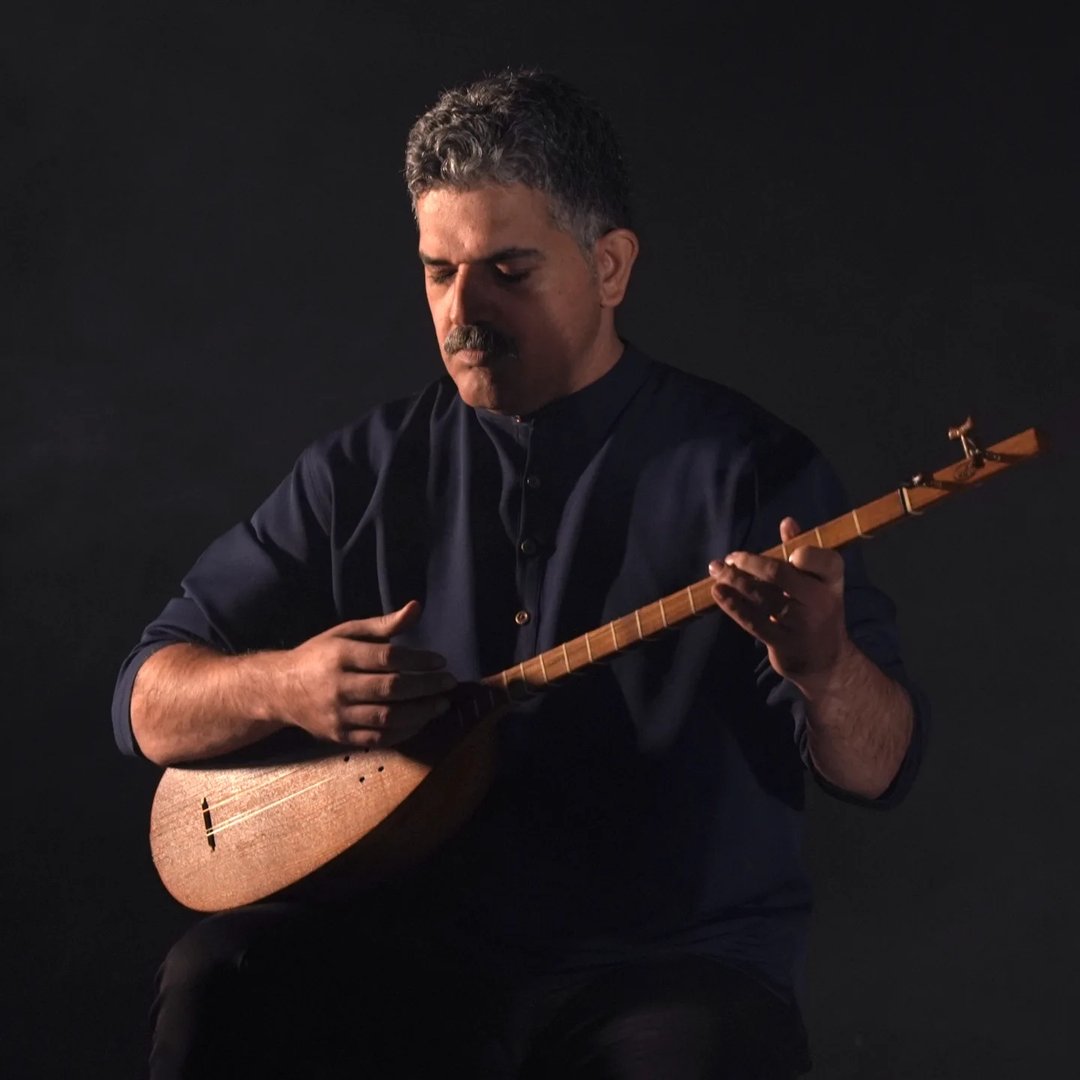
Tahmoures Pournazeri (born 8 February 1977 in Kermanshah) is an outstanding Iranian musician, composer and instrumentalist. He comes from a musical family: he is the son of Keykhosrow Pournazeri and the elder brother of Sohrab Pournazeri. Tahmoures is regarded as one of the influential figures of contemporary Iranian music, and in his works he has crossed the boundary between traditional Iranian music and global forms. He plays the tar and setar (long-necked lutes), tanbur, barbat, daf (frame drum) and divan, and is also familiar with instruments such as the santur, tombak, kamancheh (spike fiddle), dotar and ney. His first official work as a composer was the album Ava-ye Baran (“The Sound of Rain”), released before he turned 20; in this work his innovative setar techniques were heard for the first time in Iranian music. Over more than three decades of artistic work, Tahmoures Pournazeri has collaborated as a composer, performer and arranger with Iran’s most prominent singers and instrumentalists, and has performed in Iran, Europe, America and Asia. Among his notable collaborations are joint projects with Mohammad Reza Shajarian, Homayoun Shajarian and the Shams Ensemble. His works often blend the mystical and ritual melodies of western Iran with contemporary music and global forms. Notable activities and works Album Ava-ye Baran (1995): his first venture into composition, with the voice of Bijan Kamkar. Album Diyar-e Mehr (“Land of Affection”, 2005): with the voice of Farshad Jamali, based on poems by Rumi, Partow Kermanshahi, Akhavan Sales and Hamid Mosaddegh. Album Penhan Cho Del (“Hidden Like the Heart”, 2007): with Hamidreza Nourbakhsh and the Shams Ensemble. Album Sarzamin-e Khorshid (“Land of the Sun”, 2009): a mystical work based on poems by Rumi and Iqbal Lahori. Album Afsaneh Sho (“Become a Legend”, 2010): a joint project of Iranian and Indian artists, including Shujaat Husain Khan and Arunangshu Chaudhury; a fusion of Iranian and Indian music. Album Na Fereshteham Na Sheytan (“I Am Neither Angel Nor Devil”, 2013): with the voice of Homayoun Shajarian; one of the most successful works of Iranian fusion music in the 2010s. Album Bar Sama-ye Tanbur (“To the Sama of the Tanbur”, sama being the Sufi ritual of listening and dance; 2014): a collaboration of the Shams Ensemble, Alireza Ghorbani and the Pournazeri family in honour of the tanbur tradition. Album Tanblues (from “tanbur” and “blues”, 2020): an innovative experiment linking the ancient music of the tanbur with Western blues, together with Josette Bushell-Mingo. Performances and concerts Over the years of his career Tahmoures Pournazeri has given numerous concerts and tours in Iran and abroad, including: The concert performance Baz Amadam (“I Have Returned”) (Tehran, 2023) – a fusion work featuring Sahar Mohammadi Boroujerdi and the dance-theatre group “Harekat” (“Movement”), which was cancelled because of opposition from the authorities. The concert show Si Sad (“Three Hundred”) (Saadabad Palace, 2024). The international tour Iran-e Man (“My Iran”) in Iran, Europe and Canada, with the voice of Homayoun Shajarian (2017–2019). The concert Chera Rafti (“Why Did You Leave?”) in Iran and Europe (2014–2016). Appearances at international festivals of mystical music in Konya, Belgium and France. A joint performance with Mohammad Reza Shajarian and Sohrab Pournazeri on America’s National Public Radio (NPR). Artistic approach Tahmoures Pournazeri has always emphasised dialogue between the music of East and West. His works are a blend of mystical melodies, classical Persian poetry and the modern structures of world music. In his works he strives to turn the language of Iranian music into an international idiom and to build a bridge between tradition and modernity.
Tar, setar and tanbur player and composer
b. 1991/92
Pourya Sayhoon is a tar, setar and tanbur player with his own style, as well as a composer and teacher of these instruments. He was born in Tehran in 1370 SH (1991/92). He belongs to the new generation of tanbur players and has a personal signature on the instrument. He learned the tanbur largely on his own, through self-study and personal effort, although he also studied with Mehrdad Maleki and Masoud Arzanlou. He plays tanbur in Masoud Arzanlou’s Bang-e Nowruz ensemble and has stood out in performances such as “Hamaseh-ye Dad” and “Nazm dar Zakhmeh”. Building on a sound grasp of music theory and familiarity with Iran’s regional maqam music and the tanbur maqams, Sayhoon has developed a fresh synthesis in tanbur playing. His work can be seen as an example of a trend that grew stronger among young tanbur players from the 1390s SH (2010s): pairing the tanbur with Persian poetry, and improvising and composing in the various dastgahs and gushehs, without loosening the instrument’s bond with classical Persian music. This trend speaks more directly to younger listeners, and its roots go back to works such as “Ali Guyam, Ali Juyam” by Amir Hayati, followed by the work of Seyed Khalil Alinejad and the Shams ensemble.
Tanbur player, Ravak ensemble
Ravak tanbur ensemble
Pouya Hosseinpour is a tanbur player and a member of the Ravak tanbur ensemble led by Saeed Pirzadeh, and played tanbur in the ensemble’s first published performance (November 2026). Source: the opening credits of the Ravak ensemble’s video on the YouTube channel “Tanbur Tutorials with Saeid Pirzade”. This page is short and will be expanded.
Singer, musician and instrument maker
b. 1987/88
Ranaei Family Ensemble
Pouyan Ranaei is a singer, musician and instrument maker. He was born in 1987 (1366 SH) in Sahneh into a musical family and learned the tanbur from childhood with his father, Seyed Yahya Ranaei. He studied tombak, kamancheh and singing with masters such as Dariush Zargari, Ali-Akbar Shekarchi and Mozaffar Shafiei, and learned to build setars and tanburs from his father and mother; today he also makes instruments. He is the vocalist of the series “Maqamat-e Kohan-e Tanbur” (Ancient Maqams of the Tanbur), researched and played on the tanbur by his father, whose first volume appeared in 2019 (see also volumes two, three, four and five). The family performs as the Ranaei Family Ensemble. His YouTube channel mostly shares his father’s tanbur performances and joint performances of father and son, such as “Maqam-e Tarz” and “Maqam-e Bal-vashan” as handed down by Yahya Ranaei. Sources: Musiceiranian (2019); Pouyan Ranaei’s YouTube channel (@PouyanRanaei). Biography rewritten by Tanburban.
Tanbur player, Soule Mast ensemble
Soule Mast tanbur ensemble
Raheleh Yousefzadeh is a tanbur player and member of the Soule Mast tanbur ensemble led by Ebrahim Tehranipour. This page is short and will be expanded.
Composer, singer and tanbur player
b. 1973/74
Ali Asghar Rahimi, a composer, singer and tanbur player, was born in Isfahan in 1352 SH (1973/74). He began playing the tanbur in 1370 SH (1991/92) with teachers such as Touraj Honarjou, Seyed Ali Jaberi and Mozaffar Berenji, and later learned the maqams (traditional melodic pieces of the tanbur) of both tanbur traditions from Seyed Amrollah Shah-Ebrahimi and Taher Yarveysi. In 1376 SH (1997/98), at the invitation of the Isfahan Conservatory of Music, he started the first tanbur class in Isfahan province. In 1377 SH (1998/99) he founded the Rouhafza music ensemble and led it in concerts in Iran and abroad, among them a performance with Taher Yarveysi in Isfahan in 1390 SH (2011/12). The Isfahan Tanbur Association, devoted to maqam music, was registered and opened with the support of the Isfahan municipality in 1393 SH (2014/15), and Rahimi heads it. In the same year the Cultural Heritage Organization appointed him to the expert committee for registering intangible heritage in music. He is also a member of the House of Music of Iran, since 2016 he has directed the Yasna ensemble, and he founded the company Yasna Production. Besides the usual plucking techniques, Rahimi uses strumming patterns of his own on the tanbur, and as a composer he draws on the possibilities of the tanbur maqams. The poetry of Rumi, Omar Khayyam and Ain al-Qudat Hamadani inspires much of his work. His compositions include Saman-buyan (1375 SH, 1996/97), on a poem by Hafez sung by Pouran Ahmadi, in which he plays tanbur, bass tanbur and soprano tanbur himself; Hengam-e Sahar; and the music videos Dam-e Isavi and Sahebdam, which he composed and sang. Sahebdam, directed by Payam Davoudi, was commissioned by UNESCO and produced by the Creativity and Innovation Centre of the Isfahan municipality. His artist profile lists the projects Invisible Fire, Shams and Tanbour, Death to Birth, Sound of Rumi and Chants of Light, the album Ancestral Dialects (2019) and the score for the film Simin (2018). In April 2018 an album of his settings of Rumi sung by Shahram Nazeri was announced; a performance of the maqam Sarukhani with Nazeri singing and Rahimi on tanbur was also shared by the channel “Navaye Tanbur”. His first concert series in Romania took place in 1392 SH (2013/14) at the invitation of the Iranian embassy, and much of his later work has been in that country. In August and September 2017 he presented Sound of Rumi at the National Theatre in Bucharest and gave a concert and lecture at the invitation of the National University of Music Bucharest. In February 2018, in the joint concert Chants of Light with the Romanian Byzantine choir Evloghia, he brought tanbur maqams together with Christian liturgical chant, and in July 2018 he performed his compositions at the Râșnov festival with artists from Romania, Bosnia and Hungary. In 2017 he was one of forty musicians, chosen from 1,700 applicants worldwide, invited to the fourth edition of the Visa for Music festival in Morocco. The daf player Mohsen Taherzadeh accompanied him, and musicians from Gambia, Guinea, Niger and Burkina Faso joined him in shared performances; according to the channel, this was the first time tanbur maqams were combined with traditional African music. On 3 May 2018 the Yasna ensemble under his direction performed the programme Helhela at a “Night of Iranian Music” in the main hall of the Qatar National Theatre in Doha. He has also performed in Turkey (at the Mevlana festivals in Konya), the United Kingdom, Nepal, Lebanon, Russia and Finland. According to the “Navaye Tanbur” channel (June 2026), Rahimi has released his compositions and his way of playing and singing on ten albums in Iran and abroad, among them “Bangi Ajab” with Shahram Nazeri, and has composed music for several feature films and television documentaries. On the album “Madad” he set old styles of praise-singing for Imam Ali in various forms of darvish singing; its pieces are “Sahba”, “Darvish”, “Mey-parast”, “Hengam-e Sahar”, “Hu”, “Do Su”, “Saheb-dam” and “Madad”. The same text adds South Africa and France to the countries where he has given concerts and workshops. Sources: Telegram channel “Navaye Tanbur”, February 2017 to July 2018 and June 2026 (partly quoting IRNA and others); Hamshahri newspaper (Isfahan edition), interview by Saeed Emami Abarghouei, April 2018; artist profile on Ethnocloud and his website.
Composer, tanbur player and instrument maker
b. 1961
Afshin Ramin is one of the well-known and influential figures of Iranian maqam music (music built on traditional melodic models called maqams). He was born in the summer of 1961 in the city of Kermanshah and from childhood was captivated by the melodies and folk instruments of his hometown. At the age of twelve he began studying music under Master Keykhosrow Pournazeri – one of the founders of the Shams Ensemble and a veteran of Kurdish music – and very soon revealed his great talent and flair for playing the tanbur and the setar (a small long-necked lute). The beginning of his artistic path In 1985 Afshin Ramin joined the renowned Shams Ensemble as a player and, alongside masters and artists such as Shahram Nazeri and Tahmoures and Sohrab Pournazeri, took part in numerous performances in Iran and abroad. In the 1980s and 1990s he worked with various ensembles of traditional and maqam music and played an active role in introducing mystical and Kurdish music to Iranian and international audiences. In later years he devoted himself to teaching music in Kermanshah and held numerous classes in tanbur, setar and Iranian music theory. Official and professional work In 1995 he began working with the Music and Song Centre of Islamic Republic of Iran Broadcasting (IRIB), the state broadcaster, and in 2001 he was employed by the organisation as an official expert on maqam and regional music. Over these years, besides performing live and composing, Afshin Ramin also served as head of the Music and Song Archive and played an effective role in collecting and preserving the music of Iran’s regions. Works and collaborations Afshin Ramin has taken part in the production and performance of numerous works, some of which are counted among the landmark works of Iranian maqam music. Among them: Album Delara (“Heart’s Delight”) – co-composed with Tahmoures Pournazeri, sung by Hesameddin Seraj Albums Heyrani (“Bewilderment”), Motreb-e Mahtabru (“The Moon-Faced Minstrel”) and Afsaneh-ye Tanbur (“The Legend of the Tanbur”) – as player and composer Album Mah Didam (“I Saw the Moon”, 2023) – a fusion work inspired by the poems of Mowlana Jalaleddin Rumi In addition to these works, he has composed numerous pieces in the Iranian dastgahs (the modal systems of Persian classical music) that are registered in the National Music Archive, including Naqsh-e Dust (“The Image of the Friend”), Neshaneh (“The Sign”) and Montazeram Ke Biyai (“I’m Waiting for You to Come”). Musical style Afshin Ramin’s style is a blend of the authenticity of Kurdistan’s maqam music and a fresh approach to structure and performance. Drawing on the spiritual and mystical qualities of the tanbur, he has created pieces which, for all their simplicity, are full of emotional and spiritual depth. His approach of bringing together Iran’s traditional music and new musical spaces has made his works appealing both to lovers of maqam music and to contemporary audiences. Teaching activities Afshin Ramin has always regarded teaching and passing on musical knowledge as an inseparable part of his artistic mission. Over the years he has trained many students in Kermanshah and Tehran and, through workshops and specialist seminars, has helped to broaden public knowledge of tanbur music and of Iran’s mystical music. Artistic legacy Afshin Ramin belongs to the generation of artists who have played a prominent role in preserving and continuing the musical traditions of Iran’s regions. With a committed and scholarly outlook, he has sought to take maqam music beyond its local framework and present it in a global form. His works are a combination of feeling, authenticity and thought, and for this reason they have remained a lasting part of the aural memory of Iranian music.
Composer, researcher and tanbur player
b. 1990/91
Ramtin Kakavandi is a composer, music researcher, author and player of the tanbur, daf, tar and setar, born in Kermanshah in 1369 SH (1990/91). The tanbur and daf are his main instruments, but he is also skilled on the setar, oud, tar and several other instruments. Life and training Kakavandi began studying music at a young age with Seyed Khalil Alinejad and soon established himself in the tanbur field. A large part of his work is devoted to transcribing and analysing the maqam music of the tanbur, especially the Sahneh school and the tanbur of Lakestan. Albums 1393 SH (2014/15): “Pol-i be Su-ye Khorshid”, tanbur maqam music 1394 SH (2015/16): “Maktab-e Musiqi-ye Tanbur-e Sahneh” (The Sahneh School of Tanbur Music), a video album of tanbur maqam performances 1396 SH (2017/18): “Amad Nadid Beraft”, within the framework of the Persian radif 1396 SH (2017/18): “Yadegar-e Ruzegar-e Tar”, within the framework of the Persian radif 1397 SH (2018/19): “Marno”, arranged for symphony orchestra Books 1393 SH (2014/15): “Shiveh-ye Novin-e Amukhtan-e Daf” (A New Method for Learning the Daf), beginner to intermediate level, Dastan publishing 1393 SH (2014/15): “Morvarid-e Mast-e Bidari”, ten pieces for tar and setar, Dastan publishing 1396 SH (2017/18): “72 Maqams of the Tanbur”, a transcription of the Sahneh tanbur school, Aref Music publishing 1398 SH (2019/20): “72 Exercises for the Tanbur”, an introductory tanbur method, Sorud publishing 1399 SH (2020/21): “72 Foundations of the Tanbur”, the theoretical foundations of tanbur maqam music, Aref Music publishing 1400 SH (2021/22): “Tanbur-e Lakestan”, a transcription and analytical study of the maqam music of the Lak tanbur, Aref Music publishing His other writings include “Khof-e Darreh-ye Khamush” and “Hamzad-e Hamrang-e Haras” (daf duets). “72 Maqams of the Tanbur” is a broader collection than the book “Maqam-ha-ye Bastani-ye Tanbur” (The Ancient Maqams of the Tanbur), and some consider it, after Seyed Khalil Alinejad’s “Tanbur az Dirbaz ta Konun” (The Tanbur from Ancient Times to the Present), a standard reference on the tanbur. “Tanbur-e Lakestan” deals with the tanbur maqam music of Lakestan and the rules of playing in that period; in it Kakavandi analyses and transcribes the maqams on the basis of the playing of Emamqoli Emami, one of the most prominent tanbur players and heirs of Lakestan’s musical heritage, and also discusses how the maqams came into being.
Tanbur, tar and oud player; composer and arranger
Ranaei Family Ensemble
Shouresh Ranaei (also Koohzad Ranaei) plays the tanbur, tar, setar, oud and kamancheh and is a composer and arranger. He is the son of Seyed Yahya Ranaei and the brother of Pouyan Ranaei, and has played the tanbur with his brother since childhood; a recording of the two brothers playing the tanbur in 1994 survives. He arranges the works of the Ranaei Family Ensemble, among them “Bani Adam”, “Motreb-e Tanbur” and Yawaran Masem, composed by his father. He also plays the tanbur in the family’s maqam performances, such as an improvisation with his father and the maqam “Savar Savar” (spring 2023), and supervised the recordings of the project to collect the tanbur maqams of Sahneh (2017) with his father and Pouyan. In 2019 he founded the Shoorideh Orchestra; its first work was “Bekhan be Mouyeh”, on a poem by Ahmad Heydarbeigi and sung by Pouyan Ranaei, dedicated to Mohammad-Reza Shajarian. Most of his work is recorded at the Shoorideh music studio. He has often performed with Japanese musicians, including concerts in Tokyo in 2014 and a tour of Hong Kong and Japan in 2018. Source: the Ranaei Family Ensemble’s YouTube channel.
Composer, tanbur player, singer and instrument maker
b. 1962/63
Ranaei Family Ensemble
Seyed Yahya Ranaei was born in 1962 in Sahneh. At the age of 12 he learned authentic tanbur playing with the late Master Seyed Amrollah Shahebrahimi, and after completing the maqams (the traditional melodies of the tanbur repertoire) of the Sahneh tradition, he became a student of Master Abedin Khademi in order to master the playing of the Guran maqams as fully as possible. He learned the sacred (Haqqani) and ancient maqams of the Sahneh tradition from him, the maqams of the Guran region from Master Abedin Khademi, and traditional Persian music and setar playing (the setar is a small long-necked lute) from the masters Jalal Zolfonun and Hossein Alizadeh. He also benefited from the guidance of masters such as Hossein Ruhtafi, Seyed Ayaz Ghazvinei, Darvish Amir Hayati, Seyed Nemat Zolnuri, Seyed Nur-Mohammad Zakiabadi and Seyed Ezzat Yari in Sahneh, and Seyed Vali Hosseini, Taher Yarveysi, Seyed Mansour Yari and Kiumars Khaledpour in the Guran region. After nearly fifty years of activity and research in this field, having received various awards and achieved many successes, he was able to play an effective role in introducing this instrument and making it better known, by forming various music groups, including the Ranaei Family Ensemble, and through successful performances in Iran and abroad, including in France, Norway, Sweden, Japan and Turkey. His compositions include Motreb-e Tanbur (“The Tanbur Minstrel”), Bani Adam Aza-ye Yekdigarand (“The Children of Adam Are Limbs of One Another”, dedicated to the survivors of the tsunami in Japan), Rotl-e Geran (“The Brimming Goblet”), Yawaran Masem (“Friends, I Am Drunk”), Fada-ye Dust (“A Sacrifice for the Beloved”) and Badeh-Nushan (“The Wine Drinkers”), as well as other works that will be released on the albums of Daftar-e Motreb-e Tanbur (“The Book of the Tanbur Minstrel”). Today he remains active in music, giving concerts, composing, making instruments and teaching music. Maqamat-e Kohan-e Tanbur 5 is the fifth disc in the series Maqamat-e Kohan-e Tanbur (“Ancient Tanbur Maqams”), released with research and tanbur playing by Yahya Ranaei and vocals by Pouyan Ranaei. Yahya Ranaei says of this collection: “The tanbur is one of the oldest and richest treasures of Iran’s culture and art. The magnificent presence of the tanbur throughout the history of this land moved me to collect the sacred (Haqqani), devotional and ancient maqams of the Yarsan people (followers of the Yarsan or Ahl-e Haqq faith, a mystical religion of western Iran). These maqams were composed and shaped in the Sahneh region and around Lakestan from about the 10th century to the middle of the 17th century.” Seyed Yahya Ranaei was a member of the ensemble Hamnavazan-e Tanbur (“The Tanbur Ensemble”) – led by Seyed Amrollah Shahebrahimi – and has given many performances, both with the ensemble and as a soloist: Performance at the Festival of Culture and People in Isfahan Performances at Vahdat Hall and on IRIB (the Iranian state broadcaster) in 1976–1977 First place at the school students’ festival and an honorary diploma in music Member of the tanbur ensemble of the Centre for the Preservation and Propagation of Music, Kermanshah province Concerts in Iran and abroad Teaching tanbur and setar
Scribe of the Yari daftars, author and tanbur player
b. 1956/57
A great man whose name rings sweetly in the ear of every devout believer, and who is counted among the well-known figures of the Yari faith: this great Yarsan figure is none other than Agha Seyed Amin Rasaei. Seyed Amin was born in 1335 SH (1956/57) into a devout family in the village of Gurehjub Moradbeyg. Spiritual matters and, more generally, faith, religion and piety were so important in his family, and held such a high place, that already in early childhood he developed a remarkable inclination towards and intimacy with spiritual things and the precious teachings of the Yarsan, including the playing of the sacred instrument, the tanbur; so much so that at the age of seven, among a number of Yarsan elders, he played the maqam (a traditional melodic piece of the tanbur) Bariyeh for the first time. He was a younger son of Agha Seyed Karim and the brother of the late Agha Seyed Rahbar and of Agha Seyed Safar Rasaei, and under the guidance of Agha Seyed Karim, himself a master of the tanbur maqams, he learned this sacred instrument while still a child. In the study, interpretation and understanding of the precious teachings of the daftars (the Yarsan sacred books), however, it was his esteemed brother Agha Seyed Rahbar who took on this important task and became his teacher. It should be added that his brother Agha Seyed Rahbar was so touched by divine grace that it was as if something were being inspired within him, which brought him into a state of rapture; this was so intense that he became madly thirsty for the encounter with God, lost himself and entered the world of rapture and intoxication with the Divine Essence. For this reason, in 1347 SH (1968/69), in this very state of rapture, he fell from the peak of Divanegah, left the transient world and attained the nearness of God. After his brother's death, Seyed Amin made full use of his brother's daftar writings and himself turned to copying the sacred Yari daftars. Among these copies are the blessed daftar of Darvish Nowruz, made in 1350 SH (1971/72), and the daftar of Darvish Barakhas Biyamehi, Darvish Hoseynali and Darvish Vali Majrilani, made in Bahman 1353 SH (January/February 1975). Notably, at the time of the Baathist regime's invasion of Iranian territory, he was held captive in a foreign country for ten years, from 1359 to 1369 SH (1980/81 to 1990/91). Even then, true to his lofty spirit and devotion to the sacred tenets of the Yarsan, in the confines of his captivity he set up classes in tanbur playing, daftar reading and the interpretation of the daftars for his fellow Yarsan prisoners, who numbered some 77, and, drawing on his knowledge of these languages, taught English and French to Yarsan and non-Yarsan prisoners alike. Remarkably, in order to spread the rites and sacred values of the Yarsan faith, including tanbur playing, among his brothers in faith, this esteemed Seyed managed to build tanburs out of the most basic materials, which were rarely to be found, and to teach the Yarsan prisoners there to play. Agha Seyed Amin Rasaei is one of the few people who played a very important role for their friends and brothers in faith in upholding the Yari faith and the sacred norms and values of the Yarsan, such as tanbur playing and daftar reading, and who thus repaid his debt to the faith despite the harsh conditions of the enemy camps and the complete lack of freedom and adequate means. When his captivity ended and he returned home in 1372 SH (1993/94), he devoted himself to copying the daftars of the Forty (Chehel-tan) of Seyed Brakeh. He is the author of numerous articles and works, among them: the valuable book Rahrovan va Baqa-ye Javedan (“The Wayfarers and Eternal Abiding”), 361 pages covering ten subjects, 1382 SH (2003/04) Taqvim-e Kordi-ye Pardiwari va Sabk-e Guran (“The Kurdish Pardiwari Calendar and the Guran Style”), 1383 SH (2004/05) the book Razha-ye Nahofteh (“Hidden Secrets”), 89 pages, 1387 SH (2008/09) Tajalli-ye Nur (“The Manifestation of Light”), 249 pages in fifteen parts, 1388 SH (2009/10) Osul va Arkan-e Yari (“Principles and Pillars of the Yari Faith”), comprising 150 pages, 1390 SH (2011/12); owing to his workload, the writing of this book has not yet been completed a critique of a book whose title the source gives as Marnavaz Dariche-ye Pardiwar (reading uncertain), 97 pages, 1391 SH (2012/13) the valuable book Pir Narges Cham, 174 pages covering 18 subjects, 1391 SH (2012/13) a critique of an interview with Seyed Borzu Daneshvar, 36 pages, 1393 SH (2014/15) a brief survey and critique of the book by Hojjat al-Eslam Mansouri, 34 pages, 1393 SH (2014/15) a critique of the book Bang-e Sarhaddan, 88 pages, 1394 SH (2015/16) and a book entitled Resaleh-ye Yari-ye Yarsan (“Treatise on the Yari Faith of the Yarsan”), 232 pages in 35 parts. At present, since 1382 SH (2003/04), on the instruction of the beloved Yarsan leader Agha Seyed Nasreddin Heydari, this great Yarsan figure has been serving the Yari faith and the whole Yarsan community as a member of the board of trustees of the holy shrine of Sultan Sahak. Source: Telegram channel “Navaye Tanbur”, 15 June 2017; written by Seyed Hekmat Hosseini; quoting the channel “Navaye Yari”.
Yarsan kalam singer
Seyed Safar Rasaei is a Yarsan kalam singer. Firooz Yousefi has published a recording of maqam “Abedineh” with him singing the kalam. No further biographical information was found in available sources. Source: Firooz Yousefi’s YouTube channel.
Tanbur player, Guran Tanbur Players
Guran Tanbur Players
Rayan Rostami is a tanbur player and a member of the Guran Tanbur Players, led by Jahanbakhsh Rostami in Shiraz, and played tanbur with the ensemble in the song “Parvaz-e Ruh” (2025) and the concert “Sokhan-e No” (2025). Sources: the description of the “Parvaz-e Ruh” video on Jahanbakhsh Rostami’s YouTube channel and the ensemble’s Instagram page. This page is short and will be expanded.
Composer and tanbur player
b. 1985/86
Edris Rezaei, a performer and composer from Kermanshah, is one of the figures of the new generation of tanbur music; his efforts focus on expanding the expressive language of the instrument and offering a new approach to tanbur playing. He was born in 1985 and began learning the tanbur with his father in his teenage years. His interest and perseverance led him in later years to continue his training with eminent tanbur masters, including Ali Akbar Moradi and Keykhosrow Pournazeri. While continuing to play, Rezaei pursued university studies in electrical engineering (power systems) at the Iran University of Science and Technology; yet his artistic path always remained at the centre of his attention. From 2008 he also took up the kamancheh (spike fiddle), learning from well-known players such as Ardeshir Kamkar and Shervin Mohajer. Edris Rezaei’s artistic vision rests on innovation in technique, the development of melody and the search for a personal voice. Alongside his stage performances, he has been teaching the tanbur for years and is considered one of the active teachers of the instrument in the specialist tanbur community. The turning point of his career is the release of his first official album, Rahi Digar (“Another Way”), a work that reflects his effort to give the tanbur a different sound and to create a new combination with percussion instruments. The album clearly shows his independent approach to composition and his unclichéd treatment of the maqams (the traditional melodic pieces of the tanbur repertoire) and structures of the tanbur.
Tanbur player and teacher of Yari maqams
b. 1986/87
Nozar Rezaei, son of Nasur, from the village of Bezmirabad of the valiant Qalkhani tribe, was born in 1365 SH (1986/87). He was still very young when he witnessed a series of classes and gatherings of daftar recitation (daftar: the Yarsan sacred books) and tanbur playing held in the Bezmirabad district through the efforts of the late Darvish Alimir Darvishi; from then on, with his father's encouragement, the first sparks of love for the tanbur and the maqam (a traditional melodic piece or mode of the tanbur) were kindled in him. In his teenage years, through effort and perseverance, he was able to complete the authentic tanbur maqams under Ghobad Ghobadi and to perform them with the utmost authenticity and beauty. He has always striven to understand the concepts of the daftars of the Yarsan community; alongside learning the tanbur maqams he has not neglected the study of the Yari daftars, and has always endeavoured to benefit as fully as possible from the Yari texts. For some years he also benefited from the teaching of the late Darvish Jahangir Darvishi. One of the subjects he has pursued in particular in recent years is the Kurdish Shahnameh: by collecting several old and reliable manuscripts he has been able both to write out a number of them and to gain a deep, research-based understanding of how the narratives of the Kurdish Shahnamehs – a vast part of the enduring heritage of our forebears – are told. For some years now he has devoted himself to teaching the Yari maqams to devotees and students, both privately and in groups, and has held regular and serious tanbur classes in Sarpol-e Zahab county and in the Bezmirabad district, Cham-e Zereshk and the surrounding area. Mindful that the maqam music of the tanbur should be at the service of the people and of those devoted to this path, he has always taken an active part in the gatherings of lovers of this ancient instrument and has been a good example of conduct and morals for young people and for those who follow this path. Source: Telegram channel “Navaye Tanbur”, 10 March 2017.
Percussionist
Hossein Rezaeinia is a percussionist. At Ostad Ali Akbar Moradi’s “Raz-e Rud” concert in Vahdat Hall, Tehran (26 May 2014), he played tanbur–percussion duets with Moradi. Source: video descriptions on Saman Soltanipour’s YouTube channel.
Mohammad Beyg Rokhbin Gurajubi
Singer of kalams and maqam songs
1908/09–1987
The late Mohammad Beyg Rokhbin Gurajubi was born in 1287 SH (1908/09), the son of Khodayar, and came from the village of Gurehjub-e Moradbeyg. Since from his childhood and youth there were great masters of kalam (the sacred hymns of the Yarsan) and tanbur in Qeshlaq and Gurehjub, he too naturally developed a particular inclination towards kalam and the authentic local melodies. He collaborated in singing maqam songs and kalams, in particular with the late Lalu Birkhan of Zardeh and the late Ka Hawas Abbasi; several cassette tapes of theirs still survive and are counted among the authentic sources. Lalu (“uncle”) Mohammad Beyg, as he was known, is likewise counted among the select masters of his time. He had a distinctive style, throat and timbre, and sang the maqams (maqam: a traditional melodic piece/mode of the tanbur) “Bariyeh”, “Gharibi”, “Mohammad Hasan Khani” and “Gol-o Khak” in an unrivalled, incomparable way. His sweet and plaintive voice moved and transformed everyone who heard it. Unfortunately, to this day no name or trace can be found of these great figures who have departed this world, although music and art are indebted to the efforts of these unknown masters. Lalu Mohammad Beyg died in his birthplace on 2 Ordibehesht 1366 SH (22 April 1987), at the age of 76. Source: Telegram channel “Navaye Tanbur”, 8 June 2017; written by Alireza Abbasi Gurajubi (Qasr-e Shirin, 18 Shahrivar 1394 SH / 9 September 2015).
Tanbur player and composer
Guran Tanbur Players
Jahanbakhsh Rostami is a tanbur player and composer. His official YouTube channel has published several of his tanbur solos and improvisations (2017–2018) and the song “Parvaz-e Ruh” (2025), which he composed and arranged; it is sung by Mohammad Rezazadeh with a large ensemble of tanbur and daf players. He teaches the tanbur in Shiraz and leads and composes for the Guran Tanbur Players, a large ensemble made up mostly of his students; its concert “Sokhan-e No” was performed in Shiraz and Larestan in 2025. Source: his official YouTube channel (@jahanbakhshrostamiofficial). Also: his Instagram page and the Guran Tanbur Players’ Instagram page.
Tanbur player and teacher, director of the Ravak ensemble
Ravak tanbur ensemble
Saeed Pirzadeh is a tanbur player and teacher who directs and arranges for the Ravak tanbur ensemble. His YouTube channel “Tanbur lessons with Saeed Pirzadeh” is aimed at remote learning; its introduction promises step-by-step lessons in tanbur maqams, zekrs, songs and études. Source: the YouTube channel Tanbur lessons with Saeed Pirzadeh. This page is short and will be expanded.
Maqam scholar and tanbur maker
b. 1962/63
Saeed Zolnouri (Seyed Saeed Zolnouri) is a maqam scholar, musician, teacher and master maker of the tanbur and other plucked string instruments, born in Sahneh in 1341 SH (1962/63). He is regarded as one of the foremost tanbur makers in Iran. Beginnings and the Nakisa workshop His interest in instrument making showed early. According to one account, at about fourteen, in his third year of middle school, he built a small tanbur about 25 cm long for a nationwide school art competition and took first place in his province. His first professional instrument was also a tanbur, with a bowl-shaped body, which he made by trial and error, with no previous experience and almost no tools. In 1356 SH (1977/78) he set up his own tanbur workshop in Sahneh and marked his instruments with the “Nakisa” stamp. In 1366 SH (1987/88) he moved the workshop to Tehran, and in 1374 SH (1995/96) he returned to Sahneh, the home of his forebears. Zolnouri considers Nariman his greatest teacher; by his own account he built instruments on Nariman’s models for about twenty years, so that during his Tehran years many people assumed he was Nariman’s son. Research and innovation Zolnouri has spent years researching maqam music and its instruments. The Kermanshah provincial standards office asked him to develop a standard model for the tanbur, which is now available on the official website of Iran’s national standards organisation. He also revived a unique model among the instruments of Ostad Khodaverdi, which was entered in Iran’s national register as the “double-sided tanbur” under Khodaverdi’s name. His invention of a new instrument called the “delsaz” and a new method of tanbur construction known as the “two-hundred-piece tanbur”, both with distinctive structural and resonance properties, earned him two UNESCO seals of authenticity. His concern for the environment also led him to build a tanbur that follows the model of the one-piece bowl but is made from seven pieces; this instrument, which preserves the refinements of the one-piece-bowl tanbur, has been entered in the national register. Honours and connections Zolnouri holds the first-class badge of Iran’s House of Music and has so far received two UNESCO seals of authenticity and four national awards. He was named an “enduring figure” of Kermanshah province and has also received an honorary master’s degree. In his youth he was a close friend of Seyed Khalil Alinejad, and he has many memories of him to tell. Seyed Arman Dakkei and Seyed Mohammad Zolnuri are among the players whose work he has endorsed. He sees hardship as an inseparable part of an artist’s path and believes that it is precisely these difficulties that bring both the artist and the work to maturity.
Tanbur player, Khorasan Tanbur Players
Khorasan Tanbur Players ensemble · Soule Mast tanbur ensemble
Saeedeh Ramezani is a member of the Khorasan Tanbur Players ensemble led by Ebrahim Tehranipour. She also played tanbur in the Soule Mast tanbur ensemble. This page is short and will be expanded.
Virtuoso tanbur player, maqam expert and maqam singer
b. 1948
Ali Mohammad Salimi was born in Azar 1327 SH (November/December 1948) in the village of Changar Jalilvand in the county of Eslamabad-e Gharb. From childhood he was captivated by the sounds of music, and religious and local songs and hymns fascinated him. As a teenager he was looking for a path that would lead him into the delightful world of music. Listening to cassettes of kalam (the sacred hymns of the Yarsan) introduced him to the voice of the late master Amirza Seyd Ali Kafashian, one of the outstanding and renowned maqam experts (maqams being the traditional melodic pieces of the tanbur) and tanbur players of Yarsan ritual music. It was as if he had found what he had been missing. Master Kafashian's lovely voice poured drop by drop, like sweet water, into the young Ali Mohammad, yet it did not quench his thirst. He was thirsty to learn and looked for someone who could teach him the ABC of tanbur playing. On a short trip he got to know the late master Seyed Vali Hosseini in person, and within a short time showed that, besides great eagerness, he had an extraordinary talent for playing the tanbur. This acquaintance marked the beginning of a deep relationship between the master and his eager pupil, and beyond that it brought the two families together. In Seyed Vali Hosseini's school the teenage pupil was so devoted, perceptive and thoughtful that the master always spoke of him as one of his best pupils. His visits to Seyed Vali gave the young pupil the opportunity to learn the ritual maqams of the tanbur and the ritual kalams of the Yarsan from their source, namely the Guran region and its masters. The late Darvish Moradkhan Gurajubi and the late Darvish Alimir Darvishi were other masters of maqam knowledge and maqam singing in whose presence Darvish Ali Mohammad learned, besides tanbur playing and maqam singing, the secrets of interpreting the Yarsan daftars (the Yarsan sacred books). His eagerness to learn was so deeply rooted in him that he used every opportunity to glean from the knowledge of the elders and masters of his time. His friendship with Darvish Ali Mirza Nazari was another of the opportunities Darvish Ali Mohammad used to complete what he had learned. A great love of the Yarsan ritual maqams, gleaning from great and renowned masters, eagerness to learn, a keen intelligence in grasping religious interpretations, and a rich talent for tanbur playing and maqam singing brought Ali Mohammad to the level of a master while still young. Even so, he has never considered himself beyond the need to learn, and he always regards himself as indebted to his masters, who introduced him to the sweet spring of the maqams of kalam and tanbur. Alongside his own learning, Master Ali Mohammad Salimi has devoted himself to teaching what he learned from renowned masters. Many pupils have been trained in his school, among them his brother Valad Salimi, his nephew (sister's son) Sirous Karami, and his children Peyman and Darvish Salimi. So that enthusiasts may benefit from his lovely voice and masterly tanbur playing, this rare maqam expert and maqam singer has, together with his pupils, recorded 72 tanbur maqams and prepared them for release, but so far he has not succeeded in obtaining a distribution permit. Source: Telegram channel “Navaye Tanbur”, 13 July 2017.
Tanbur player, Soule Mast ensemble
Soule Mast tanbur ensemble
Sana Ghazi is a tanbur player and member of the Soule Mast tanbur ensemble led by Ebrahim Tehranipour. This page is short and will be expanded.
Tanbur player, Khorasan Tanbur Players
Khorasan Tanbur Players ensemble · Soule Mast tanbur ensemble
Sara Nowruzi is a member of the Khorasan Tanbur Players ensemble led by Ebrahim Tehranipour. She also played tanbur in the Soule Mast tanbur ensemble. This page is short and will be expanded.
Member of the Khorasan Tanbur Players
Khorasan Tanbur Players ensemble
Sara Rad is a member of the Khorasan Tanbur Players ensemble led by Ebrahim Tehranipour. This page is short and will be expanded.
Tanbur, setar, dotar and barbat player
Soheil Sargolzaei is an Iranian musician who plays tanbur, setar, Khorasani dotar and barbat, and aims to introduce traditional Iranian music to a wider audience. On his YouTube channel he has published improvisations and versions of tanbur maqams such as Jelowshahi, Savar-savar, Majnuni and Yavaran mastam, and he often plays tanbur duets with Shahab Karami, including at Baba Yadegar and by the Ghuslan spring. Source: his YouTube channel (@soheilsz).
Tanbur player, Guran Tanbur Players
Guran Tanbur Players
Sarina Mirzaei is a tanbur player and a member of the Guran Tanbur Players, led by Jahanbakhsh Rostami in Shiraz, and played tanbur with the ensemble in the song “Parvaz-e Ruh” (2025) and the concert “Sokhan-e No” (2025). Sources: the description of the “Parvaz-e Ruh” video on Jahanbakhsh Rostami’s YouTube channel and the ensemble’s Instagram page. This page is short and will be expanded.
Tanbur player, Guran Tanbur Players
Guran Tanbur Players
Sedigheh Kazemi is a tanbur player and a member of the Guran Tanbur Players, led by Jahanbakhsh Rostami in Shiraz, and played tanbur with the ensemble in the song “Parvaz-e Ruh” (2025) and the concert “Sokhan-e No” (2025). Sources: the description of the “Parvaz-e Ruh” video on Jahanbakhsh Rostami’s YouTube channel and the ensemble’s Instagram page. This page is short and will be expanded.
Tanbur player, Moshtagh Tanbur Ensemble
Moshtagh Tanbur Ensemble
Serveh Faraji is a tanbur player and a member of the Moshtagh Tanbur Ensemble in Sanandaj, led by Jalil Rahmati, and played tanbur in “Hoo Madadi” in memory of Mohammad-Reza Lotfi (October 2025). Source: the closing credits of the “Hoo Madadi” video on the Moshtagh Tanbur Ensemble’s YouTube channel. This page is short and will be expanded.
Tanbur player
Guran Tanbur Players
Setareh Hemmatian is a tanbur player. In October 2025 they played tanbur with Arian Sheikhi in an excerpt of the folk piece “Ey dad o bidad” arranged by Davood Azad, recorded with four tanburs, kamancheh and daf at the Mah-Soltan mansion in Shiraz. Setareh Hemmatian also is a member of the Guran Tanbur Players, led by Jahanbakhsh Rostami in Shiraz, and played tanbur with the ensemble in the song “Parvaz-e Ruh” (2025) and the concert “Sokhan-e No” (2025). Source: the description of the video “Ey dad o bidad” on Arian Sheikhi’s YouTube channel. This page is short and will be expanded. For the Guran ensemble: the description of the “Parvaz-e Ruh” video.
Tanbur narrator (ravi) of the Sahneh school
1927–2021
Seyed Ahmad Hosseini was one of the great narrators (ravi) of the tanbur in the Sahneh tradition and belonged to the old generation of Iranian tanbur players. The son of Seyed Morad, he was born on 11 Khordad 1306 (2 June 1927) in the village of Baktar-e Sofla. He lost his father at seven, moved to Hamadan at fourteen and to Tehran at eighteen. He was invited many times to perform on the radio but always declined. In the 1990s he served, with Ali-Akbar Shekarchi and Houshang Zarif, on the jury of several editions of the Fajr Music Festival. According to his student Reza Aliabadi, his versions of the maqams had a beauty and character of their own, and his playing stood out among his generation for its innovation and clean execution. Many masters learned from him. Death Seyed Ahmad Hosseini died of old age, aged 94, on Wednesday 20 Esfand 1399 (10 March 2021) at Mehr Hospital in Tehran. The maqam Jelowshahi Marking the first anniversary of his death, on 21 Esfand 1400 (12 March 2022), Reza Aliabadi released the maqam "Jelowshahi" as handed down by his teacher – according to Aliabadi the first studio recording of this maqam. It changes mode five or six times, and halfway through its strumming pattern shifts and the rhythm quickens. Aliabadi said he was the only one of Hosseini's students who had mastered it and saw the release as a student's tribute to his master. Source: Musiceiranian (musiceiranian.ir) — سید احمد حسینی، راوی بزرگ تنبور صحنه درگذشت; بازنوازی اثر نوازنده فقید تنبور در اولین سالگرد درگذشتش
Tanbur player, composer and improviser
b. 1982/83
Delasa Music Group · Yadegar-e Vesal ensemble
Family and roots Seyed Arman Dakkei was born in the city of Kermanshah. Both his paternal and maternal lines are style-bearing tanbur families, each with its own tradition of the instrument; according to the family, the tanbur has been preserved and passed on in these two families for nearly a thousand years. Growing up among Kurdish minstrels and men of Kurdish letters, he followed Kurdish music and literature in their way. Notable forebears include Sheikh Amir, after whom the Sheikh Amiri tuning is named, and Seyed Farzi on his mother's side, and Seyed Ebrahim Dakkei on his father's side. Raised in a world rich in Kurdish poetry, he began teaching the tanbur at fifteen, in the styles of the Dakkei and Ghazvineh families. Training As a teenager, to enter the world of Persian classical music, he studied the tar, the urban instrument, with Seyed Mohammad Zanouri, a student of Hossein Alizadeh. Along the way he also learned from Fariborz Azizi and Pir Ataei, and through Zanouri he attended master classes by Hossein Alizadeh. Before that he had entered a music faculty, where he studied with the late Rahman Moradi, a student of Mohammad Reza Lotfi. Collaborations As a young man he worked for a decade with Shahram Nazeri through the Ferdowsi music ensemble. This led to many concerts performing Ferdowsi's Shahnameh, a video recording of the Shahnameh story The Uprising of Kaveh the Blacksmith, and an audio work of the Kurdish Shahnameh, The Battle of Rostam and Sohrab. He also performed for two years in concerts of Davood Azad. Iranian Academy of Arts Together with Dr. Bahman Kazemi, then head of the regional music department, he organised Iran's first tanbur workshop at the Iranian Academy of Arts. For a time he headed the Academy's cultural section for the Shahnameh and mythology, which produced translations of eleven volumes of Kurdish Shahnameh stories. One volume, The Mourning of Siavash as told by Almas Khan Kandoulei, was published by the Iranian Academy of Arts with an audio CD of the Kurdish and Persian readings in his voice and ten hours of compositions and maqam playing.
Tanbur narrator (ravi) of Lakestan
1934/35–2020
Seyed Hasan Khan-Beygi, a maqam tanbur player of the Laki tradition of Delfan, was one of the last survivors of the golden generation of tanbur maqam music in the Laki-speaking region (Delfan and Tarhan, Nurabad and Kuhdasht). He was born in 1313 (1934/35) in the village of Golam Bahri in Delfan, Lorestan province. Before him, masters such as Emamqoli Emami, Najafali Mirzaei and Seyed Hemmatollah Hosseini had been known in this tradition. He had no single teacher. He learned the Yari maqams of Delfan, in which he was a master, from his father, and picked up other maqams such as Paveh-Muri, Sahari, Maleh-Zhiri and Chupi from the older players of his youth. Farid Elhami's tribute After his death Farid Elhami wrote a tribute for Musiceiranian. In Elhami's words, a "ravi" (narrator) is a maqam master who plays the maqams close to their source, without alterations or techniques borrowed from other instruments, and who also stands high in ethics and conduct – generous, hospitable and respected by the community. He counts Seyed Hasan among the last tanbur narrators of the Laki-speaking region, alongside Taher Yarveysi in Guran and Seyed Lotfollah and Seyed Ayaz in Sahneh. Elhami recalls several meetings and the videos he holds of him, and describes a simple, honest man who narrated the maqams of Lakestan without pretension and with authenticity, among them the maqam "Yari", "Maleh-Zhiri" and the Paveh-Muri "Hanay-e Mohammad Beg". Death Seyed Hasan Khan-Beygi died on the evening of Monday 29 Ordibehesht 1399 (18 May 2020) in Delfan county. Source: Musiceiranian (musiceiranian.ir) — راوی و پیر تنبورِ لکستان در گذشت; فرید الهامی به یاد زنده یاد سید حسن خان بیگی نوشت
Tanbur player
Delasa Music Group
Seyed Hooman Rootabi is a tanbur player who played tanbur in “Raz-e Hallaj” (spring 2021) by the Delasa music group. Source: the description of the Delasa group’s video “Raz-e Hallaj” on YouTube. This page is short and will be expanded.
Didgeridoo player
Delasa Music Group
Seyed Masih Sadat Hosseini is a didgeridoo player who played in “Raz-e Hallaj” (spring 2021) by the Delasa music group. Source: the description of the Delasa group’s video “Raz-e Hallaj” on YouTube. This page is short and will be expanded.
Tanbur player
b. 1980/81
Cherikeh Tanbur Ensemble · Delasa Music Group
Seyed Salman Hosseini is a tanbur and setar player, born in Sahneh in 1359 SH (1980/81). He learned the tanbur from early childhood with his grandfather, Seyed Ghadamyar Hosseini, a veteran kalam singer and maqam authority who was born in Baktar-e Sofla in 1272 SH (1893/94), died in 1393 SH (2014/15) and, because of his exceptionally long life, was known as the “Pir-e Tanbur” (elder of the tanbur). Keykhosrow Pournazeri and Ali Akbar Moradi were also among his students. From the age of twelve Salman studied setar with Shahram Moradi, and in 1383 SH (2004/05) he entered university to study music, with setar as his principal instrument. He also learned from teachers such as Masoud Shoari, Mostafa Kamal Pourtorab, Amir Ashraf Arianpour, Mohammad Sarir and Dehlavi. In 1384 SH (2005/06) he founded the Cherikeh ensemble, with which he gave a concert at Andisheh Hall. He has appeared in television programmes and has also played with the Nasl-e Khalil tanbur ensemble. He is counted among the new generation of tanbur players and, together with musicians such as Seyed Arman Dakkei, has helped keep the Sahneh style and the memory of Seyed Ghadamyar alive. He composed the piece “Shahsavar-e Vakht”. His playing, rooted in what he learned from his grandfather, has an archaic character. Although he reads notation and is familiar with modern music theory, he believes in teaching the tanbur orally and by ear, and he remains firmly attached to the old manner of playing.
Tanbur player
Delasa Music Group
Seyedeh Samaneh Mousavi is a tanbur player who played tanbur in “Raz-e Hallaj” (spring 2021) by the Delasa music group. Source: the description of the Delasa group’s video “Raz-e Hallaj” on YouTube. This page is short and will be expanded.
Tanbur player, Guran Tanbur Players
Guran Tanbur Players
Shadab Rastgou is a tanbur player and a member of the Guran Tanbur Players, led by Jahanbakhsh Rostami in Shiraz, and played tanbur with the ensemble in the song “Parvaz-e Ruh” (2025) and the concert “Sokhan-e No” (2025). Sources: the description of the “Parvaz-e Ruh” video on Jahanbakhsh Rostami’s YouTube channel and the ensemble’s Instagram page. This page is short and will be expanded.
Tanbur player and teacher, leader of the Kabook ensemble
Dr Adib Shahebrahimi is a tanbur player and teacher and the leader and arranger of the Kabook ensemble. On his YouTube channel he has published tanbur lessons (tuning, right-hand technique, the pieces “Navaei” and “Ali guyam Ali juyam”), performances of old tanbur maqams, pieces of his own and videos on instrument making. He also holds doctorates in contemporary Western philosophy and political sociology. Source: his YouTube channel (@Dr.Adib.Shahebrahimi).
Tanbur player and teacher
1923/24–2003/04
Seyed Amrollah Shahebrahimi (1923–2003) is one of the most outstanding figures in the history of the tanbur and one of the principal revivers of this ancient instrument in modern times. He was born in Sahneh county into a family devoted to music and spirituality. His father, Seyed Lotfollah Shahebrahimi, was his first teacher and gave him a deep familiarity with the ancient maqams of the tanbur, its traditional melodic pieces, from early childhood. Shahebrahimi went on to study with eminent masters of maqam music and Iranian music, and besides the tanbur he also became acquainted with the tar and setar (long-necked lutes) and with the fundamentals of the radif, the core repertoire of Iran’s classical music. This breadth of knowledge made his playing structured and technically assured, yet faithful to the ancient authentic traditions. The 1970s were the turning point of his life. At a time when the tanbur was not yet a recognised instrument in official music circles, Shahebrahimi worked tirelessly to teach it and make it known once more. He set up the first formal tanbur classes in Sahneh and then, by forming the first ensembles of tanbur players, he brought the instrument out of its limited ritual setting and onto concert stages and festivals. These efforts played an important part in restoring the tanbur to its rightful place in Iranian music. His many students – among them a number of the most renowned players of the next generation – each made a great contribution to spreading and introducing the tanbur, and turned the Shahebrahimi school into one of the most deeply rooted currents in maqam music today. The only official recording he left behind, the album Sama (named after the Sufi ritual of listening and dance), contains a collection of authentic tanbur maqams and solos – works that are now considered among the reliable sources for understanding his playing style and his musical world. Alongside his dazzling skill, Shahebrahimi was known for his humility, his kindness and his scholarly precision in teaching. He always upheld the authenticity of the maqams and urged his students to respect the roots precisely and to avoid distortion. Seyed Amrollah Shahebrahimi passed away in 2003 in his birthplace; yet the fruit of his life – the revival of the tanbur, the founding of modern teaching for the instrument and the training of a new generation of artists – has kept his name alive and enduring.
Composer and tanbur player
b. 1979/80
Meghdad Shahhosseini (1979, Tehran) He began his artistic activity in 1990 by learning the tombak (a goblet drum) and the setar (a small long-necked Persian lute), and in 1995 he went on to study singing with Master Afsaneh Rasaei. At the same time he learned the tar (a long-necked Persian lute) with the late Master Houshang Zarif, and in 1999 he entered the Faculty of Art and Architecture to study music, learning Western and Eastern music theory, harmony, counterpoint and more from teachers such as Farhad Fakhreddini, Kambiz Roshanravan, Mostafa Kamal Pourtorab, Farid Omran, Hooman Asadi, Dariush Talai, Majid Kiani, Dariush Pirniakan and others. In 2001 he learned the radif of Taherzadeh (the radif being the core repertoire of Iran’s classical, dastgah-based music) with the late Master Razavi Sarvestani, and afterwards some old songs with the late Master Hassan Salek Esfahani. From 2001 he also studied the tanbur, a ritual instrument, benefiting from some of its masters, such as the late Taher Yarveysi and others. Among the works in which he has taken part are films and series such as Rastegaran (“The Redeemed”), Bidarbash (“Wake-Up Call”), Dudkesh (“The Chimney”), Paytakht (“The Capital”) and Paridokht, as well as the vocals for the title song of the series Ruz-e Hasrat (“Day of Regret”) and others, all with music by Arya Aziminejad; the documentary Baz Ay (“Come Back”), made for the Year of Rumi; and the album Az Zabur-e Tanhayi (“From the Psalms of Solitude”) by Seyed Ali Jaberi. His other works as a composer include musical idents for the channels Al-Kawthar, Press TV, Channel 2, Shoma, iFilm, Channel 5 and others, as well as the scores for the films Bur (Soran Ghaneifar) and Ruberu-ye Aftab (“Facing the Sun”), the series Fasli Digar (“Another Season”), the documentaries Royan (Meysam Shahhosseini), Gonbad-e Giti (“The Dome of the World”, Mahmoud Nazeri) and Khaterat-e Khaneh-ye Matruk (“Memories of the Abandoned House”, Mehdi Farsi), and the short films Atash-e Khodi (“Friendly Fire”, Behnam Alizadeh) and Chavi Nan (Khaled Farajzadeh), among others.
Tanbur player from Guran
Khamush Shahidi is a tanbur player from the Guran region. In a video on Kakabarar Ostad’s channel he plays Pardivari and majlesi maqams of Guran with Masoud Ostad, Morad Ostad and students. Source: Kakabarar Ostad’s YouTube channel.
Composer and tanbur player
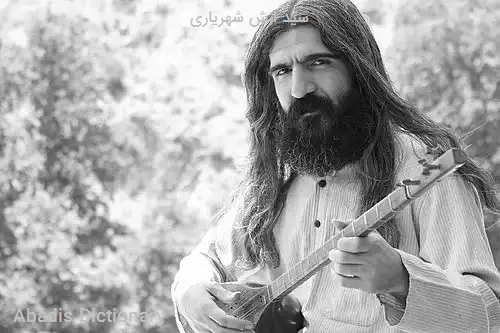
Seyed Arash Shahriari began learning the tanbur at the age of five with his father, Seyed Rokneddin Shahriari. His grandfather had also played this instrument. He went on to learn from eminent masters and experts in the maqams (the traditional melodic pieces of the tanbur repertoire) such as Seyed Ghasem Afzali, Seyed Amrollah Shahebrahimi, Baba Gholam Hemmatabadi and Shafi Khaledi Kimenei, and through long practice and extensive research he gained a deep knowledge of the maqams and techniques of the tanbur. Besides maqam music, Shahriari has also drawn on the knowledge of eminent musicians of Iran’s dastgah music (the classical system of modes), including Seyed Morteza Molaei in singing, Ali Mohammad Khan Khazaei on the tar (a long-necked lute), and renowned masters such as Mohammad Reza Lotfi and Dariush Talai on the tar and setar (a smaller long-necked lute). Today he is known as a performer, maqam expert, master of the radif (the core repertoire of Iran’s classical music) and composer. In 1999 Seyed Arash Shahriari founded the Ruhtaf Ensemble, and with this group, as well as in solo performances, he has given numerous concerts in Iran and in various other countries. The fruit of his years of experience and research is a personal and coherent interpretation of the different styles of tanbur playing in the Guran and Sahneh schools. In performing the instrumental and vocal maqams of the tanbur, Shahriari has arrived at an original and personal style while remaining faithful to tradition, and this is regarded as the distinctive feature of his work. In the field of dastgah music, too, his command of the old styles of tar playing and his knowledge of the principles of iqa (musical metre) in Iran’s early music have led him to a new language of composition, a language that forges a deep connection between maqam music and dastgah music. Seyed Arash Shahriari has presented Iranian music at numerous international festivals and events, including: participation in the spring festival of UCLA in the United States (2009) and in the Folk Music project devoted to Iran’s dastgah and maqam music, an appearance at the Joinville Festival of Sacred Music in France (2009) with the ensemble “Nava-ye Zohreh” (“The Song of Venus”), which he directed and composed for, a performance and two workshops on tanbur music and dastgah music at the Rondalla Festival in the Philippines (2011), participation in the International Conference on Indo-European Songs at the Tchaikovsky Conservatory in Moscow (2013), and a performance of maqam and dastgah music at the 4020 Festival in Linz, Austria (2018). Shahriari has trained many students in the maqam music of the tanbur and in Iranian dastgah music (tar and setar), and is recognised as a master in these fields. One of his innovations is the design of the chahartar (“four strings”), an instrument that has been used in performing works attributed to Abd al-Qadir Maraghi. Among Seyed Arash Shahriari’s published works are the albums Marsiyeh-ye Aftab (“Elegy for the Sun”) and Mashgh-e Nam-e Leyli (“Writing Out Leyli’s Name”). His other work includes the music for the film Chigh (“The Reed Screen”), directed by Mohammad Reza Aslani, and the two music videos Meymand and Soltaniyeh. He collaborated with Mohammad Reza Darvishi on composing and performing parts of the music for the films Atash-e Sabz (“Green Fire”; the songs Bineshan, “Traceless”, and Sahari Moshtagh, “Yearning at Dawn”) and Ghali-ye Sokhangu (“The Talking Carpet”), for the stage play Shab-e Hezar-o-Yek Mu (“The Night of a Thousand and One Hairs”) and for the project Shoghnameh (“The Book of Longing”; works of Abd al-Qadir Maraghi). From a long interview with Musiceiranian (2014) A double heritage. Shahriari says music is hereditary in his family, whose forebears kept takyehs, jamkhanehs and khanqahs. His father came from Kerend (Guran tradition) and his mother from Sahneh, and his maternal ancestor Seyed Aslan Shah-Ebrahimi was one of the region's sages – so he learned the maqams of both traditions at first hand. Besides his father, an aunt who is a master of maqam singing and tanbur, and his grandmother, from whom he learned many old maqams, shaped him most. He learned the Guran maqams in full from Seyed Qasem Afzali and the majlesi and ancient maqams from Majid Yazdani, a pupil of Mirza Seyd-Ali Kafashian; he then studied with Seyed Amrollah Shah-Ebrahimi, and his deepest spiritual influence was Baba Gholam Hemmatabadi. Two traditions and a third view. In his view the maqams of Guran and Sahneh are the same; they differ in tone, accent and style. The Guran version is more untouched and weightier and focuses on precise preservation of the vocal parts, while instrumental narration has been stronger in Sahneh and is more accessible to listeners of Persian classical music. He describes an "inner" view as a third approach, in which the tanbur is no longer an instrument but part of the player's being, and sees it above all in Baba Gholam Hemmatabadi – a farmer of simple life who also mastered the sorna and dohol, who in Shahriari's account revived the "audible zekr" with the tanbur and led Nariman Abnousi to tanbur making. Tarz and the number of maqams. Shahriari holds that all tanbur maqams derive from the maqam "Tarz": from its opening comes Rast, from which Shah-Khoshini and Kakaradayi emerge, followed by Oshshaq, the basis of many maqams. He speaks of 72 special maqams associated with the era of Soltan Eshaq (14th century, or 7th century AH) and of prayer-like maqams attributed to the elders, and puts the total number of maqams above 360. He calls the majlesi maqams the ancient maqams that can be played anywhere, unlike maqams tied to particular times and rituals. In November 2012 he gave a concert of maqam and adwar-based music at Vahdat Hall, and he had earlier worked with Mohammadreza Darvishi on the "Shoq-nameh" project (works attributed to Abd al-Qadir Maraghi). Juror at the Youth Music Festival (2021) As a juror of the regional-music section of the 15th National Youth Music Festival, Shahriari said that after the Persian radif, tanbur music is Iran's most powerful classical system, and that the tanbur and related instruments – the dotars of Khorasan and Mazandaran, the ashiq saz – should be called "regional classical music" rather than regional music. His judging criteria are, in order, the authenticity of the maqam, technique within that school, and tuning, which he considers even more important than technique. Source: Musiceiranian (musiceiranian.ir) — گفت وگو با «سید آرش شهریاری»، مقامدان و نوازنده تنبور و تار; آرش شهریاری: جشنواره موسیقی جوان در رشد تنبور کمک کرده است
Member of the Khorasan Tanbur Players
Khorasan Tanbur Players ensemble
Shahrzad Tabrizi is a member of the Khorasan Tanbur Players ensemble led by Ebrahim Tehranipour. This page is short and will be expanded.
Tanbur player
Kaveh Shakouri is a tanbur player. On the YouTube channel “Navaye Tanbur” he plays works by Ramin Kakavand (“Meykhaneh” and a pishdaramad) and Kaykhosrow Pournazeri (“Mardan-e Khoda”). Source: the YouTube channel “Navaye Tanbur”.
Tanbur player and teacher
b. 1999
Shamim Jafari is a tanbur player and teacher from Rasht and one of the active tanbur figures in Gilan. She is counted among the women of the new generation of tanbur players in Iran — a generation that has turned to maqam music in recent years through steady training and study with well-known masters. Life and first encounter with the tanbur Shamim Jafari was born on 6 October 1999 (14 Mehr 1378 SH) in Rasht. She first encountered the tanbur in 2018 on a short trip to Sahneh in Kermanshah province — a journey that, according to her profile, changed the course of her artistic life and connected her to the world of Iran’s maqam music. Teachers After this first encounter she began practising remotely and then continued with several masters of the tanbur and setar. The most important names on her path are: Mozaffar Mansourian Farid Elhami Masoud Shoari Studying with these teachers became a turning point in shaping her artistic identity. The Okhan ensemble Together with several young musicians from Rasht, Jafari founded the Okhan ensemble, which has left a number of maqam performances. Teaching She now teaches tanbur in Rasht and, beyond in-person classes, runs online courses for students across Iran and abroad. Her teaching puts three things first: understanding the roots of maqam music; correct playing technique; passing on the mood and spirituality of the tanbur. For course information and lessons she can be reached on Instagram or Telegram. Artistic outlook Shamim Jafari regards maqam music as an inseparable part of Iranian cultural identity and seeks to keep this old heritage alive through teaching and performance. Alongside players such as Shirin Mohammadi and Parastoo Panahi, she is counted among the influential women of the tanbur in Iran. Source: her profile on tanbur-music.ir.
Tanbur and dutar player, singer and instrument maker
Ali Sharifi is a tanbur and dutar player, singer and instrument maker in Mashhad. He is of Kurdish origin from Kermanshah, and the “Navaye Tanbur” channel introduced him as one of the dutar masters of Khorasan and a tanbur teacher in Mashhad. His performances in the channel include tanbur maqams (traditional melodic pieces of the tanbur) such as Qatar, Sarukhani, Hejrani (Allahveysi), Baba Na'usi and Jelowshahi, music of northern and southern Khorasan on the dutar, such as the maqams “Allah”, “Jafarqoli” and “Allah Mazareh”, and Kurdish, Lori and Khorasani songs sung by himself. In April and May 2017 (Ordibehesht–Khordad 1396 SH) the channel published a six-part series of notes by him on the tanbur: the history of the instrument and its family, its outward features, making the bowl, how to recognise a good instrument, making and fitting the neck, and fitting the soundboard. In his workshop in Mashhad, the “Sharifi Art Workshop”, he makes tanburs, dutars, setars, tars and sornas and repairs traditional instruments. In Esfand 1400 SH (February–March 2022) the workshop presented a twin tanbur called “Lefani” (Kurdish for “twins”), which, according to the workshop, was the first of its kind made in Iran. Collaborations and performances shown in the channel include: playing the tanbur at the launch of the last album of the late Gholamali Pouratayi in Mashhad (11 Esfand 1396 SH, 2 March 2018), and singing with the tanbur at the Shahnameh Hall in Mashhad (17 Esfand 1396 SH, 8 March 2018); duets with Mehdi Bonyadi (kamancheh) and Hamed Sharifi (tombak and daf); singing with Ramin Kaliaei on tanbur in the maqams Qatar and Gol-o Khak, recorded at the Roshandel studio in Mashhad in autumn 1399 SH (2020); playing the tanbur at the Ayyarkhaneh and Museum of Pahlavani Rituals in Mashhad, with the morshed Hojjat Ghasemi (Tir 1400 SH, July 2021) and with recitation by Kazem Shabzendehdar; singing in a trio in Mashhad with Ali Shekofteh (dutar and arrangement) and Mehrdad Motabassem (daf). In Dey 1398 SH (December 2019) the channel published a note in which he asked tanbur masters and Iran's cultural heritage organisation to act to prevent the tanbur from being registered under another country's name. Source: Telegram channel “Navaye Tanbur”, 2017–2025.
Tanbur player, Ravak ensemble
Ravak tanbur ensemble
Shayan Pirzadeh is a tanbur player and a member of the Ravak tanbur ensemble led by Saeed Pirzadeh, and played tanbur in the ensemble’s first published performance (November 2026). Source: the opening credits of the Ravak ensemble’s video on the YouTube channel “Tanbur Tutorials with Saeid Pirzade”. This page is short and will be expanded.