11 – Maqam (Tarz) Agha Yar Davud (“Our Lord Davud”)
1 view · Jan 19, 2015
Range: E, F, G, A♭, B (and B♭)
Variable notes: B.
Time signatures in the metric sections: 6/4.
Tuning: Haft Dastan or Barz (C, C, G)
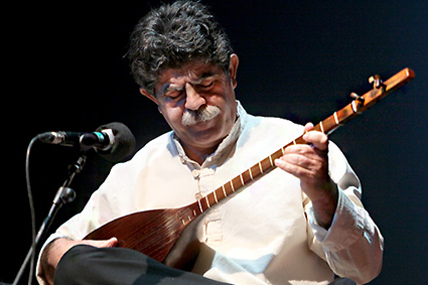
This is one of the kalam maqams – sacred maqams (melodic-modal pieces of the tanbur repertoire) sung to the sacred verse of the Yarsan (Ahl-e Haqq) – and it is accompanied by hand-clapping. This maqam has a two-beat rhythm and, according to Heydar Kaki, “is performed mostly in the jam ceremony [the Yarsan ritual gathering] when the shrines of the Yarsan leaders are circumambulated (especially the shrine of Davud).” Heydar Kaki also points out that “Taher Yarveysi, Kaka Mirza and Seyed Ghobad Hosseini likewise believe that this maqam was composed by Turkic-speaking pirs [elders] of the Yarsan in the Pardivar period and dedicated to Holy Davud, since the Turkish word san, meaning ‘you’, is used in this maqam.” This maqam is mostly performed in the Barz tuning, and its sarband (refrain) is the first couplet:
Agha yar Davu
San san yar Davu
Our lord, O Holy Davud, you alone are the friend of us poor ones.
As said before, jam means gathering at an agreed place to hold the rites of the assemblies of the Yarsan faith, in which music and tanbur playing are among the principal pillars. This place can be a particular house, the home of one of the companions, or the surroundings of Yarsan shrines. The room in which the Yarsan ritual ceremony is held must also be clean, and a sarband (head covering) and a shal (sash for girding the waist) must be ready for each person present at the jam. Davud and the jam are mentioned in this maqam because Davud saved the jam, that is, the heart of the Yarsan faith. Going by the text of the poem, the jams, in the sea of the world and its storms (the historical wars against the Yarsan), seem to be likened to a storm-tossed ship that Davud rescued and in the end made victorious over all the seas (the adversaries). Note that Davud is the symbol of Esrafil (the archangel Israfil) and of the resurrection; that is, Davud brought the resurrection upon the adversaries. Indeed, the book Saranjam (“The Conclusion”) also states on page 436: “There are two seas between God and His servant: one the sea of perdition, the other the sea of salvation. On the sea of perdition five ships sail: one greed, another hypocrisy, another persistence in sin, the fourth heedlessness, the fifth despondency (hopelessness). On the sea of salvation, too, five ships sail: one fear, another hope, another abstinence, the fourth gnosis, the fifth the affirmation of God’s oneness.” Perhaps the sea and the ship in the text of this maqam also mean these very things.
Bargah Bargah, in turn, means “Court after Court”; it is the source of the maqam’s text and forms one of the chapters of the Saranjam, in which it is stated that Hallaj was a manifestation of Davud (Hallaj lived in the third century AH / 9th century CE). Bargah is another word for the jameh or dun – the bodily incarnations – of every human being (passing from bargah to bargah). Seyed Ghobad Hosseini, however, believes that Bargah Bargah was also the same as Baria Baria. In this connection it should be noted that national allusions are more frequent in the Bargah Bargah section than in all the other sections of the Saranjam; for example, Rostam is presented as a manifestation of Benyamin, and the Simurgh as a manifestation of Khatun-e Ramzbar. According to Bargah Bargah, the Yarsan trace their religion back to Zoroaster. Zoroaster is also called a prophet of God and praised there, and it contains a myth about the beginning of the creation of the world that may be a reflection of the Zoroastrian creation myths. The opening part of this account also has strong Zurvanite elements and tells of the emanation of Ahura Mazda and Ahriman from the womb of Zurvan. The poems of Bargah Bargah are all ten-syllable lines of two hemistichs (each hemistich of five syllables). Syllabic verse is one of the remnants and elements of ancient Iran that survive among the Ahl-e Haqq.
People
Tanbur
Comments
Sign in to commentNo comments yet. Be the first.