02 – Maqam (Tarz) Baria or Barbadi (attributed to the musician Barbad)
3 views · Jan 19, 2015
Range: C, E, F, G, A (and A♭), B (and B♭).
Variable notes: A, B.
Time signatures in the metric sections: 2/8, 5/8.
Lavach (sections): Introduction, Baria avaz (unmetered vocal section).
Tuning: Haft Dastan or Barz (C, C, G)
The maqam Baria is one of the tanbur’s majlesi (secular, gathering) and ancient maqams (melodic-modal pieces of the tanbur repertoire). The metric part of this maqam has a five-beat rhythm that is played on the instrument alone, and, as mentioned, the maqam consists of two lavach (gushehs, i.e. melodic units): 1- Introduction 2- Baria avaz. In fact, the division into gushehs and the building of a larger dastgah (a modal system of Persian classical music) with the help of gushehs have their roots in tanbur music.
According to Heydar Kaki, “This maqam must be played exclusively in the ‘Barz tuning’, or Haft Dastan. Like the maqam Ghatar, Baria also begins on the note G, and chromatic semitones play an important role in it. This maqam has been handed down only in the Guran region and nowhere else where the Yarsan (the Ahl-e Haqq religious community) live. The reason for this is the particular geography of Guran, which has kept it largely pristine and untouched by cultural incursions. According to a historical tradition, the Yarsan community mostly believes that this maqam was composed by Barbad, the famous musician of the Sasanian period who lived in the time of Khosrow Parviz. For this reason, the maqam Baria is considered the oldest maqam of the tanbur.” It should be noted that in the time of Khosrow Parviz, Kermanshah was this king’s summer capital. In the view of Farzad Bazgir, because of the sorrow in the vocal part of the maqam Baria, this maqam is, among the tanbur maqams, the one most similar to the mur song – a song that women, and sometimes men, raise at mourning ceremonies and in grief at the loss of their loved ones, and which comes in various forms. Indeed, in the view of this eminent researcher, all the majlesi maqams of the tanbur actually derive from the melodies of hureh and mur.
Hurehs are the mythical songs of Iran, sung in the Kurdish language. The hureh maqams are: 1- Gela Khak 2- Gela va Dara 3- Bala Dastani 4- Shah Hosseini 5- Sarukhani 6- Jelowshai 7- Tarz 8- Majnuni 9- Sahari 10- Baria 11- Do Bala 12- Gharivi 13- Ban Banei 14- Pava Muri. Many hurehs share their names with tanbur maqams and are close to them. Today no instrument is used in hureh singing, but in the past hureh was performed together with the tanbur. The poems sung in hureh usually have 10 syllables and lyrical and epic themes. Kurdish warriors also used to sing hureh in battle.
The translation given for Baria is: “the one who has gone on a journey”. Baria is probably none other than Anbar Khatun, in separation from whom the poet mourns and burns with grief. The poem of this maqam is also by Mowlavi Kord, who was mentioned earlier.
People
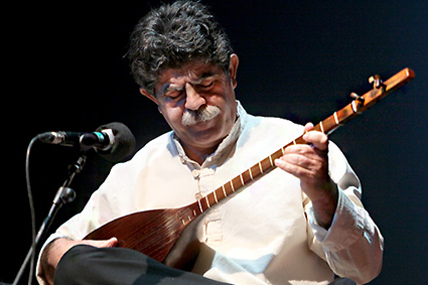
Tanbur
Comments
Sign in to commentNo comments yet. Be the first.