01 – Maqam (Tarz) Ghatar or Ghetar (“One after Another”)
8 views · Jan 19, 2015
Range: C, D, E♭, F, G (and G♭), A (and A♭).
Variable notes: G, A.
Time signatures in the metric sections: 7/8, 10/8.
Tuning: Panj Dastan or Tarz (C, C, F)
This maqam (a melodic-modal piece of the tanbur repertoire) is one of the tanbur’s majlesi (secular, gathering) and ancient maqams. Farough Safizadeh believes that Ghetar may derive from the word “Gatha”, and that in ancient history this maqam may have been known by that very name, Gatha. In this connection it should be noted that “gath”, or gat, means “hymn” in the Pahlavi language; adding the plural suffix “-an” turns it into “gathan”, meaning “hymns”. In the Avesta, too, the section of hymns is recorded under the title Gathan (Gahan) or Gathaha (Gataha), and to this day it is performed with a kind of chant. In fact, the Gatha is the root of the “gosan” (the Parthian minstrel) and of gosani art (minstrelsy).
According to Heydar Kaki, “The most important version of this maqam is the singing of Mamosta Ali Mardan, whose performance recalls the rendition of the gusheh (a melodic unit within a dastgah) Ghatar in the dastgah (a modal system of Persian classical music) Bayat-e Tork by Abdollah Davami. Although this maqam begins in free meter, it ends with a 10-beat rhythm; this metric section evokes the maqam ‘Sahari’ and is played on the notes of Sahari. The chromatic semitones played in this maqam are also the same semitones that are used in the maqam ‘Sar Tarz’, where, in the ‘Tarz tuning’, they start a fourth higher, from the note F. So, as has been said, the most important feature of this maqam is its use of chromatic semitones, which recalls a kind of music of ancient Iran; today the performance of such intervals has been forgotten in Iranian music.”
As for the poem of the maqam, Mowlavi Kord must be mentioned, a renowned poet and mystic of the thirteenth century AH, i.e. the 19th century CE (1221–1299 AH / 1806–1882 CE), and a follower of the Naqshbandi order. The death of Mowlavi Kord’s wife, named “Anbar Khatun”, affected him deeply, and he composed many poignant love poems. From this it becomes clear that the poem of the maqam Ghetar was composed in mourning for Anbar Khatun.
People
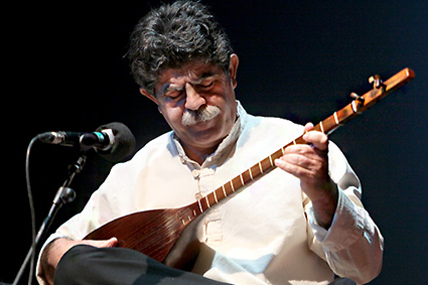
Tanbur
Comments
Sign in to commentNo comments yet. Be the first.