25 – Maqam (Tarz) Hey Dayar Dayar (“O Dweller of the Cloister, O Elder”)
1 view · Jan 19, 2015
Range: D, E, F, G.
Time signatures in the metric sections: 6/4.
Tuning: Haft Dastan or Barz (C, C, G)
It is one of the kalam maqams (sacred melodic-modal pieces in the tanbur repertoire of the Yarsan, or Ahl-e Haqq) and has a fixed 6-beat meter. Its refrain (sarband) is the first couplet, and those present respond to it by clapping:
Hey dayar dayar hahaha haha dayar
Haghan khavankar hahaha haha dayar
The Lord of the world is pure Truth and has become manifest in the form of the Beloved (Yar).
According to accounts in the Yarsan daftars (books of sacred verse), this maqam was played and sung for Shah Khoshin by one of his companions, a tanbur player named Soltan Chelavi, at their first meeting. “Dayar” is also the name of an area 60 km west of Kermanshah, where there is a sacred spring. As for Mobarakshah, known as Shah Khoshin (406–467 AH / 1016–1075 CE), from whose daftar the poem of this maqam comes, we know that he was one of the first leaders of the Yarsan, who lived in the fourth century AH (10th century CE), and that according to Yarsan beliefs Shah Khoshin, like Jesus, was born of a virgin mother. According to tradition, Shah Khoshin’s grandfather abandoned his mother in the mountains because she had become pregnant without a husband, but Kaka Reda (Kaka Riya) gave her the glad tidings of a child made of light. Among the Yarsan he is regarded as the first manifestation of the complete cycle of Truth. The notes of Kaka Reda, who later also became one of Shah Khoshin’s companions, state: Shah Khoshin grew up in Lorestan as a child, then went to Hamadan, where he devoted himself to the study of the sciences; in his youth he mastered all the sciences and became the teacher of teachers. He then returned to his birthplace and, at the age of thirty-two, proclaimed himself the manifestation of the Divine. He was enamored of music and the tanbur, and according to tradition and to Ali Akbar Moradi he had groups of nine hundred tanbur players. At the age of sixty-one, Shah Khoshin went swimming one day with his companions in the Gamasb River (one of the longest rivers in the country, the main branch of the Karkheh, in Nahavand County, Hamadan), sank into the depths of the water, and his pure and sanctified soul flew to the eternal world. The book Mashahir-e Ahl-e Haqq (“Notables of the Ahl-e Haqq”) also states: “Shah Khoshin had nine hundred disciples, and they were always with him in his travels and journeys and in guiding the people.” It should be mentioned that, according to one account, Baba Taher was also one of Shah Khoshin’s disciples. As for the importance of Kaka Reda, it should be said that in Shah Khoshin’s time he had the same role that Pir Benyamin had in the era of Soltan Sahak; that is, he was the manifestation of Gabriel. Farzad Bazgir has also referred to an oral account of this maqam that is very interesting: “Shah Khoshin was the herdsman of his grandfather, Mirza Amanollah, one of the governors of Lorestan, in the Baluran area, and a group of disciples and devotees stole the herd in order to draw him from that area to Dalahu. Shah Khoshin pursued them on horseback, and near Kuzaran in Kermanshah, on the edge of the Dalahu region, he reached a village called ‘Dayar’ (Dāyār) and met a crowd who came out to welcome him, playing the tanbur and singing kalam, and a man named Soltan Chelavi, at the head of the crowd, sang this maqam for him.”
People
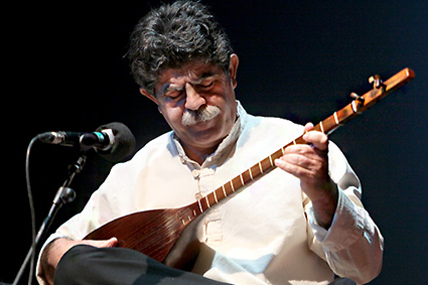
Tanbur
Comments
Sign in to commentNo comments yet. Be the first.