05 – Maqam (Tarz) Chushun Yar or Cho Vashan Yar (“How Sweet It Is That the Friend Is Coming”)
1 view · Jan 19, 2015
Range: D, E, F, G, A (and A♭), B (and B♭).
Variable notes: A, B.
Time signatures in the metric sections: 7/4, 4/4, 6/4.
Tuning: Haft Dastan or Barz (C, C, G)
It is one of the kalam (Haqqani) maqams, the sacred melodic-modal pieces of the tanbur repertoire; according to Ali Akbar Moradi, this maqam was played and sung at the birth of Soltan Sahak. Chromatic semitones play an important role in this maqam as well, and its core lies on the notes “G, A♭ and A”. According to Heydar Kaki, “This maqam is one of the metered maqams, and each of its phrases contains 17 beats”; it has a fixed refrain, which is the first couplet of the maqam:
Mayu yar dida-giani cho vashan yar
Mozgan mozganan khavandkar mayu
O light of my eyes, how sweet it is that the Friend is coming
Dear ones, good tidings to you: our Lord is coming to grace us with his presence.
Regarding Baba Sarhang, from whose book the poem of this maqam is taken, this much can be said: he lived in the fourth century AH (10th century CE) and holds one of the stations of manifestation in the history of the Yarsan, the Ahl-e Haqq religious community (after Bahlul and before Shah Khoshin). As to what “manifestation in the Yarsan faith” means, it should be said that the Yarsan believe that before Soltan Sahak there were four well-known periods of manifestation (spiritual epiphany); these individuals are, of course, only the most prominent, and the Yarsan consider their number to be greater:
1- The period of Bahlul in Lorestan (d. 219 AH / 834 CE); all his kalams and those of his companions are written down in a book called Dowreh-ye Bahlul (“The Period of Bahlul”).
2- The period of Baba Sarhang Dudani (b. 324 AH / 936 CE); all his kalams and those of his companions are preserved in a book called Dowreh-ye Baba Sarhang (“The Period of Baba Sarhang”).
3- The period of Shah Khoshin of Lorestan (b. 406 AH / 1016 CE); all his kalams and those of his companions are preserved in a book called Dowreh-ye Shah Khoshin (“The Period of Shah Khoshin”).
4- The period of Baba Naus Jaf (b. 477 AH / 1085 CE), who, like Bahlul, lived in the manner of madmen; all his kalams and those of his companions are preserved in a book called Dowreh-ye Baba Naus (“The Period of Baba Naus”).
The fifth and most complete period of manifestation, however, was that of Soltan Sahak. It should be noted, though, that in every period angels such as Gabriel, Michael, Israfil, Azrael and the Hur al-Ein were manifested in individuals, and the spiritual manifestation of persons as doctrinal symbols was not exclusive to the companions of Soltan Sahak. That is, from Bahlul to Baba Naus, all of them, like Soltan Sahak, had their “Haft Tan” (the Seven), who each symbolized Gabriel, Michael, Israfil, Azrael, the Hur al-Ein and two further spiritual leaders. Regarding the order of the manifestations, one must pay attention to the dates of these individuals’ lives, since rather different orders have also been given. But a very remarkable point about Shah Khoshin is that, according to one account, Bahlul is said to have regarded the tanbur as belonging to all Iranians, and it was from the time of Shah Khoshin, and at his command, that the tanbur became an instrument of the Yarsan’s own ritual and the religious path of this instrument was established. Besides the Shah Khoshini maqams, Farzad Bazgir also assigns the maqams “Ha Ha 1 and 2”, “Dasi Vet Vala”, “Hey Dayar Dayar” and “Yaran va Baten” to the period of Shah Khoshin.
People
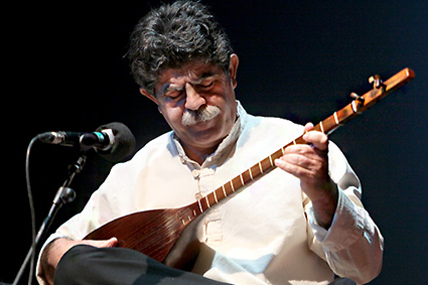
Tanbur
Comments
Sign in to commentNo comments yet. Be the first.